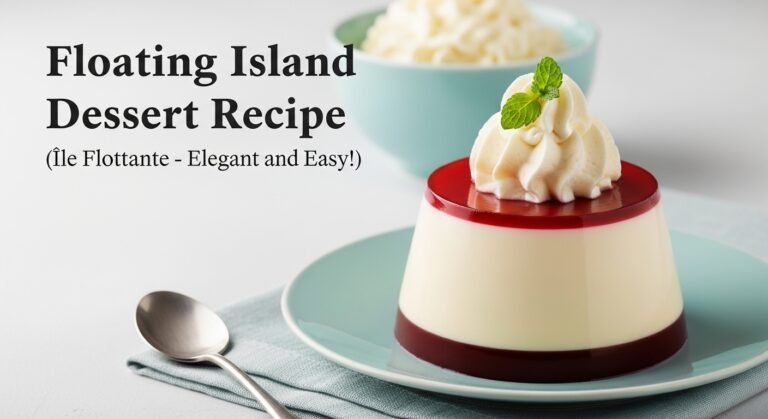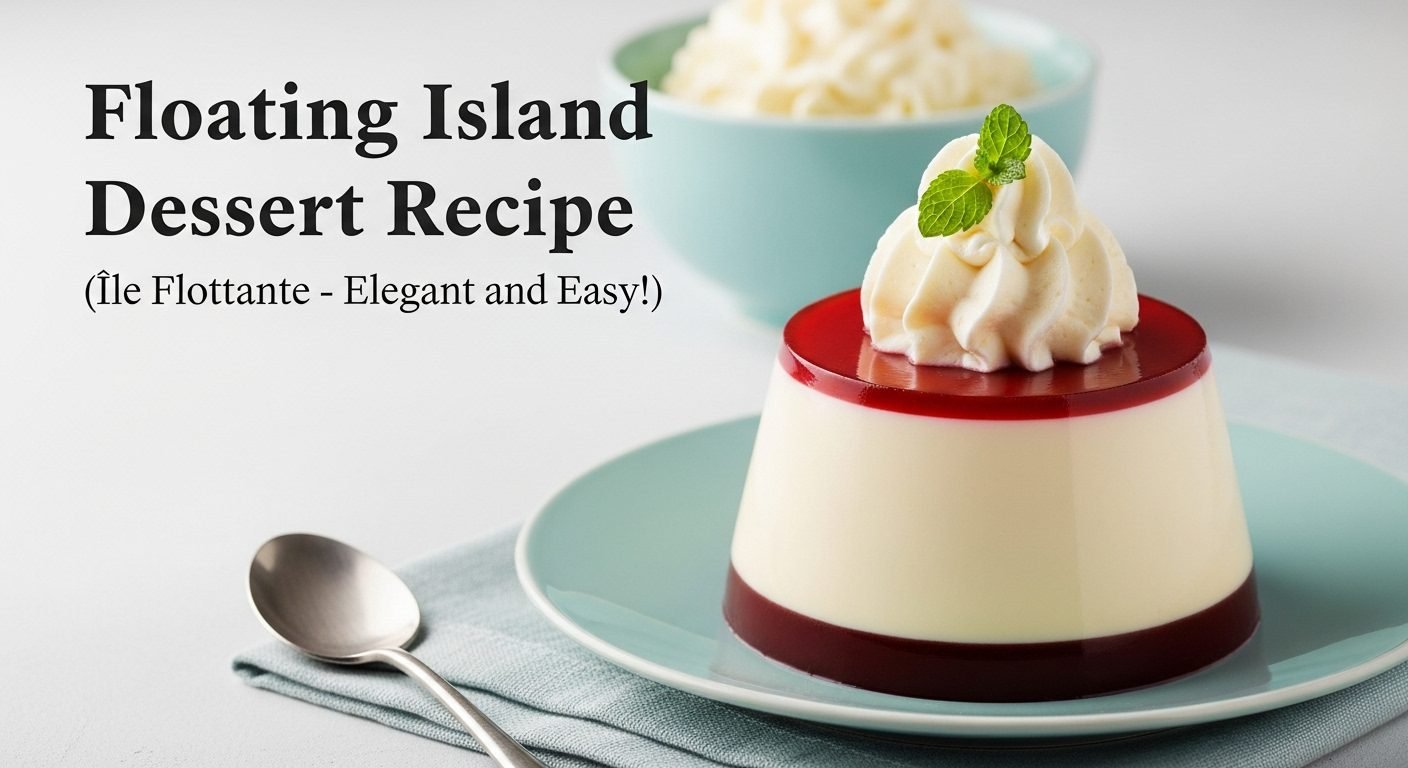
Floating Island Dessert Recipe (Île Flottante – Elegant & Easy!)
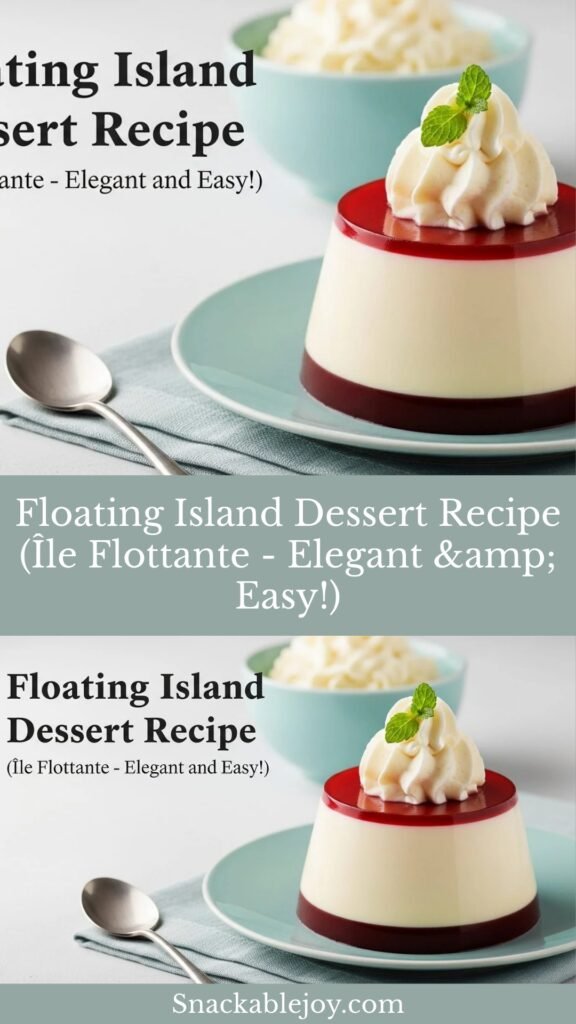
Prepare to fall in love with one of France’s most elegant yet surprisingly simple desserts! Floating Island, known as Île Flottante in French, is a show-stopping classic that looks like it came straight from a Parisian patisserie but is actually incredibly easy to make at home. This ethereal dessert features pillowy clouds of poached meringue floating gracefully on a sea of silky vanilla custard (crème anglaise), often topped with crunchy caramel threads or toasted almonds.
What makes this dessert so special is the beautiful contrast of textures—the light, airy meringue literally melts in your mouth, while the rich, smooth custard provides a luxurious base. Despite its fancy appearance, this dessert uses simple ingredients you likely already have: eggs, sugar, milk, and vanilla. It’s the perfect finale for a romantic dinner, holiday celebration, or any time you want to impress your guests without spending hours in the kitchen. The best part? You can prepare both components ahead of time, making entertaining absolutely stress-free.
History / Background
Floating Island has a fascinating history that traces back to 18th-century French cuisine, though its exact origins are somewhat mysterious and debated among culinary historians. The dessert’s French name, “Île Flottante,” literally translates to “floating island,” a poetic description of the meringue “islands” that rest atop the custard “sea.”
The dessert first appeared in French cookbooks in the 1700s, during a period when French haute cuisine was developing many of the techniques and presentations we still admire today. The original versions were even more elaborate than what we make today, sometimes featuring multiple layers of meringue decorated with candied fruits, nuts, and spun sugar. These grand presentations were served at royal banquets and aristocratic dinner parties, where presentation was just as important as taste.
Interestingly, there’s some confusion between Floating Island and a similar dessert called “Oeufs à la Neige” (Snow Eggs). While modern French cuisine often treats them as the same dessert, historically they were slightly different. Oeufs à la Neige traditionally featured individual small meringues poached in milk, while Île Flottante was originally a single large dome of meringue. Today, most restaurants and home cooks use the terms interchangeably, and both refer to poached meringue served with crème anglaise.
The dessert gained international fame through French culinary schools and restaurants, becoming a staple of classic French cuisine taught to chefs worldwide. In the 19th and 20th centuries, as French cooking influenced global gastronomy, Floating Island appeared on menus from New York to Tokyo. Julia Child famously included the recipe in her groundbreaking cookbook “Mastering the Art of French Cooking,” introducing it to American home cooks and cementing its place in the dessert canon.
What makes this dessert endure is its perfect balance of sophistication and simplicity. It represents the French culinary philosophy of transforming humble ingredients into something extraordinary through technique and presentation. The contrast between the white meringue and golden custard, the play of textures, and the delicate sweetness all embody the elegance that defines French pastry.
Today, Floating Island remains a beloved dessert in French bistros and fine dining establishments, while also being a popular choice for home cooks who want to create restaurant-quality desserts without complex equipment or ingredients.
Why You’ll Love This Recipe
This Floating Island dessert is about to become your secret weapon for impressive entertaining, and here’s why: it delivers maximum “wow factor” with minimal effort, combining restaurant elegance with home-kitchen simplicity. The ethereal meringue clouds paired with silky custard create a dessert experience that’s both visually stunning and incredibly delicious, yet the technique is far more forgiving than you might imagine.
Here’s what makes this recipe absolutely irresistible:
- Impressive presentation with simple ingredients – Create a French patisserie-worthy dessert using just eggs, milk, sugar, and vanilla—no fancy ingredients required
- Light and elegant – After a heavy meal, this airy dessert feels refreshing rather than overly filling, making it the perfect dinner party finale
- Make-ahead friendly – Both the meringue and custard can be prepared hours or even a day in advance, eliminating last-minute stress when entertaining
- Naturally gluten-free – No flour means this sophisticated dessert is safe for gluten-sensitive guests without any modifications needed
- Deceptively easy technique – Despite looking complex, the poaching method is forgiving and nearly foolproof, even for beginners
- Customizable toppings – Finish with caramel threads, toasted almonds, fresh berries, or chocolate sauce to match your personal style
- Uses leftover egg yolks – If you’ve been baking and have extra yolks, this recipe puts them to delicious use in the custard
- Budget-friendly elegance – Create a five-star restaurant dessert for pennies per serving
- Conversation starter – Guests will be fascinated by the unique preparation method and beautiful presentation
- Adaptable serving sizes – Make individual portions for plated elegance or one large meringue for family-style sharing
Ingredient Notes
Let’s break down each component so you understand exactly what you’re working with:
For the Meringue Islands:
Egg Whites – The foundation of your fluffy meringue clouds. Use large eggs at room temperature for maximum volume. Room temperature whites whip to nearly double the volume of cold whites, creating lighter, more stable meringue. Make sure there’s absolutely no trace of yolk—even a tiny bit of fat will prevent proper whipping.
Granulated Sugar – Provides sweetness and stabilizes the meringue structure. The sugar dissolves into the egg whites, creating that glossy, stable foam that holds its shape during poaching. Don’t substitute with powdered sugar, as it contains cornstarch that affects the texture.
Cream of Tartar or Lemon Juice – These acidic ingredients stabilize the egg white foam and help it hold its shape. Cream of tartar is preferred, but a few drops of lemon juice or white vinegar work perfectly in a pinch.
Vanilla Extract – Adds subtle flavor to the meringue. Pure vanilla extract is best, but imitation will work if that’s what you have.
For the Crème Anglaise (Custard):
Whole Milk – Creates the base of your custard. Whole milk (3.25% fat) provides the best balance of richness and smooth texture. You can use 2% milk, but the custard will be slightly thinner. For an ultra-rich version, replace up to half the milk with heavy cream.
Egg Yolks – The magical ingredient that thickens the custard and gives it that luxurious, velvety texture. Fresh egg yolks create a beautiful golden color and rich flavor. This is a perfect way to use the yolks left over from making the meringue!
Sugar – Sweetens the custard and helps create a smooth texture. The amount here is perfectly balanced—not too sweet, allowing the vanilla to shine through.
Vanilla Extract or Vanilla Bean – The star flavor of crème anglaise. Using a whole vanilla bean creates those beautiful speckles and intense vanilla flavor, but pure vanilla extract works wonderfully and is more budget-friendly.
Salt – Just a pinch enhances all the flavors and balances the sweetness.
Equipment Needed
Having the right tools makes this recipe smooth and stress-free:
For the Meringue:
- Large mixing bowl – Preferably glass or metal (plastic can retain oils that prevent proper whipping)
- Electric hand mixer or stand mixer – Essential for whipping egg whites to stiff peaks
- Large, wide saucepan or deep skillet – For poaching the meringue (needs to be at least 10 inches wide and 3 inches deep)
- Slotted spoon or spider strainer – For gently removing meringue from poaching liquid
- Paper towels – For draining the poached meringue
For the Custard:
- Medium saucepan – For cooking the crème anglaise
- Whisk – Essential for constant stirring to prevent curdling
- Fine-mesh strainer – For straining the custard into a smooth, silky consistency
- Large bowl – For straining the custard into
- Instant-read thermometer (optional but helpful) – For monitoring custard temperature
For Serving:
- Shallow serving bowls or plates – Individual portions look most elegant
- Ladle or large spoon – For serving the custard
Print

Floating Island Dessert Recipe
This classic French Floating Island dessert (Île Flottante) features ethereal poached meringue clouds floating on silky vanilla custard. Light, elegant, and surprisingly easy to make, it’s the perfect make-ahead dessert for impressive entertaining.
- Total Time: 55 minutes (plus chilling time) Yield: 6 servings
- Yield: 6 servings 1x
Ingredients
ScaleFor the Meringue:
- 4 large egg whites, room temperature
- ¾ cup granulated sugar
- ¼ teaspoon cream of tartar (or ½ teaspoon lemon juice)
- ½ teaspoon vanilla extract
- Pinch of salt
- 4 cups whole milk (for poaching)
For the Crème Anglaise:
- 2 cups whole milk
- 4 large egg yolks
- ⅓ cup granulated sugar
- 1 teaspoon vanilla extract (or 1 vanilla bean, split and scraped)
- Pinch of salt
Optional Toppings:
- Caramel sauce or caramel threads
- Toasted sliced almonds
- Fresh berries
- Shaved chocolate
Instructions
Make the Crème Anglaise:
- Heat the Milk: In a medium saucepan, heat the milk over medium heat until it’s steaming and small bubbles form around the edges (about 160-170°F). Don’t let it boil. If using a vanilla bean, add the pod and seeds to the milk now, remove from heat, and let steep for 15 minutes, then remove the pod.
- Whisk the Yolks: While the milk heats, whisk together the egg yolks and sugar in a medium bowl until pale yellow and slightly thickened, about 2 minutes.
- Temper the Eggs: Very slowly pour about ½ cup of the hot milk into the egg yolk mixture while whisking constantly. This gradually raises the temperature of the yolks without scrambling them. Add another ½ cup of hot milk, whisking constantly.
- Cook the Custard: Pour the tempered egg mixture back into the saucepan with the remaining milk. Cook over medium-low heat, stirring constantly with a wooden spoon or whisk, until the custard thickens enough to coat the back of a spoon and reaches 170-175°F (about 5-8 minutes). Do not let it boil or it will curdle.
- Strain and Cool: Immediately strain the custard through a fine-mesh strainer into a clean bowl. Stir in vanilla extract (if not using vanilla bean) and salt. Place plastic wrap directly on the surface to prevent a skin from forming. Refrigerate for at least 2 hours until completely chilled.
Make the Meringue:
- Prepare Poaching Liquid: In a large, wide saucepan or deep skillet, heat 4 cups of milk over medium heat until it’s barely simmering (around 180°F). Reduce heat to maintain a gentle simmer—you should see small bubbles but no rolling boil.
- Whip the Egg Whites: In a large, clean mixing bowl, beat the egg whites with cream of tartar and salt using an electric mixer on medium speed until foamy, about 1 minute. Increase speed to medium-high and gradually add the sugar, one tablespoon at a time. Continue beating until stiff, glossy peaks form, about 4-5 minutes. Add vanilla and beat for 10 more seconds.
- Shape the Meringues: Using two large spoons, form the meringue into egg-shaped ovals (quenelles). Scoop a generous amount with one spoon, then use the second spoon to smooth and shape it into an oval.
- Poach the Meringues: Gently slide the meringue ovals into the simmering milk, working in batches of 2-3 to avoid crowding. Poach for 2 minutes on the first side, then carefully flip using a slotted spoon and poach for 2 more minutes on the second side. The meringues should be firm to the touch but still soft.
- Drain: Remove meringues with a slotted spoon and place on paper towels to drain. Let cool to room temperature, then refrigerate until ready to serve.
Assemble:
- Serve: Ladle chilled crème anglaise into shallow serving bowls. Place 1-2 meringue islands on top of each portion. Drizzle with caramel sauce, sprinkle with toasted almonds, or add your favorite toppings. Serve immediately.
Notes
- The custard should coat the back of a spoon and hold a line when you run your finger through it—this is the perfect consistency.
- If your custard does curdle, immediately strain it and blend with an immersion blender to smooth it out.
- Don’t over-whip the meringue or it will become dry and grainy. Stop when you have stiff, glossy peaks.
- You can make larger meringue islands by using a ladle or measuring cup to portion them.
- The poaching milk can be strained and saved to make hot chocolate or used in other recipes.
- For perfectly smooth meringue surfaces, dip your spoons in water between shaping each one.
- Prep Time: 30 minutes
- Cook Time: 25 minutes
- Category: Desert
- Method: Stovetop, Poaching
- Cuisine: French
- Diet: Gluten Free
Nutrition
- Serving Size: 1 serving (1 meringue island with ⅓ cup custard)
- Calories: 210
- Sugar: 28g
- Sodium: 105mg
- Fat: 6g
- Saturated Fat: 3g
- Unsaturated Fat: 2.5g
- Trans Fat: 0g
- Carbohydrates: 30g
- Fiber: 0g
- Protein: 8g
- Cholesterol: 145mg
Tips & Variations
Flavor Variations:
- Chocolate Islands: Add 2 tablespoons of cocoa powder to the meringue with the sugar for chocolate-flavored clouds
- Coffee Custard: Dissolve 1 tablespoon instant espresso powder in the warm milk for a sophisticated mocha flavor
- Almond Version: Replace vanilla extract with almond extract and top with toasted sliced almonds
- Citrus Twist: Add lemon or orange zest to the custard and garnish with candied citrus peel
- Rose Water Elegance: Add ½ teaspoon rose water to the custard and garnish with crushed pistachios
- Coconut Paradise: Use coconut milk in the custard and top with toasted coconut flakes
Topping Ideas:
- Classic caramel threads (spun sugar) for dramatic presentation
- Salted caramel sauce drizzled over the top
- Fresh raspberries, strawberries, or blackberries
- Chopped praline or brittle for crunch
- Shaved dark chocolate or chocolate sauce
- Crushed amaretti cookies
- Candied violets or edible flowers for special occasions
Presentation Variations:
- Make one large meringue island in a molded shape for family-style serving
- Create mini floating islands in small glasses or espresso cups for bite-sized portions
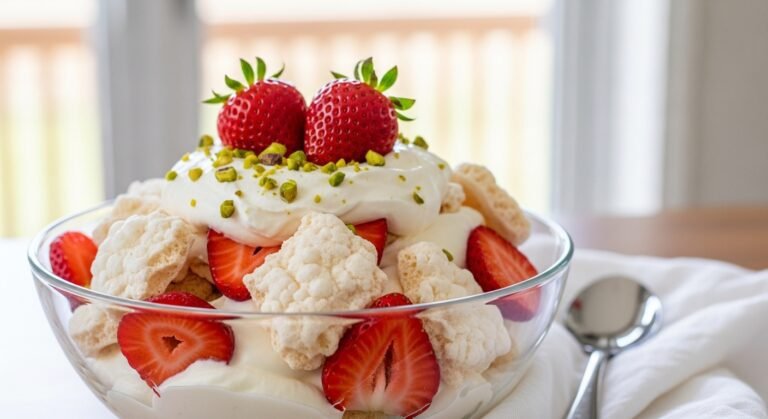
- Layer custard and broken meringue in parfait glasses for a deconstructed version
- Pipe meringue into decorative shapes before poaching for extra elegance
Pro Chef Tips
The Secret to Perfect Meringue: Room temperature egg whites are absolutely crucial—they’ll whip to nearly double the volume of cold whites. Separate your eggs while they’re cold (it’s easier), then let the whites sit on the counter for 30-60 minutes before whipping. Any trace of yolk or fat will prevent proper whipping, so make sure your bowl and beaters are spotlessly clean and completely dry.
Master the Custard Temperature: The key to silky-smooth crème anglaise is cooking it to exactly 170-175°F. Below this temperature, it won’t thicken properly. Above 180°F, the eggs will scramble. An instant-read thermometer takes the guesswork out, but you can also use the “coat the spoon” test—when you can draw a line through the custard on the back of a spoon and it holds, you’re there.
Don’t Skip the Straining: Even if your custard looks perfectly smooth, always strain it. This removes any bits of cooked egg and creates that professional, luxurious texture. Press it through with a spatula to get every last drop of that precious custard.
Poaching Liquid Temperature is Critical: The milk should be at a gentle simmer (180-190°F)—not boiling. Too hot and the meringue will collapse; too cool and it won’t cook through. You should see small bubbles rising but no rolling boil. Maintain this temperature throughout the poaching process.
The Art of Quenelle Shaping: For those perfect oval meringue shapes, use two large spoons dipped in hot water. Scoop with one spoon, then use the second spoon to smooth and transfer the meringue, creating that elegant egg shape. Practice makes perfect, but even imperfect shapes taste incredible!
Timing is Everything: Poach meringues for exactly 2 minutes per side. Under-cooked meringue will dissolve into the custard; over-cooked meringue becomes rubbery. Set a timer and don’t guess. The meringue should feel firm but still have a slight softness when gently pressed.
Prevent Custard Skin: Always press plastic wrap directly onto the surface of your custard while it cools. This prevents that unpleasant skin from forming and keeps your custard silky smooth. Cool it quickly over an ice bath if you’re in a hurry.
Common Mistakes to Avoid
Mistake #1: Adding Sugar Too Quickly to Egg Whites
Dumping all the sugar in at once prevents the egg whites from reaching their full volume and creates a grainy meringue. Always add sugar gradually, one tablespoon at a time, after the whites are foamy. This allows the sugar to dissolve properly, creating that glossy, stable meringue that holds its shape during poaching.Mistake #2: Overcooking the Custard
The moment your custard reaches 180°F or starts to bubble even slightly, you’ve gone too far. Overcooked custard becomes grainy, lumpy, or even scrambled. Cook it low and slow, stirring constantly, and remove it from heat the second it thickens enough to coat a spoon. Remember, it will continue to thicken slightly as it cools.Mistake #3: Crowding the Pan When Poaching
Trying to poach too many meringues at once causes them to stick together and makes flipping difficult. Work in batches of 2-3 meringues maximum, giving each one plenty of space. This also helps maintain the proper poaching temperature, which drops when you add too much cold meringue at once.Mistake #4: Assembling Too Early
While both components can be made ahead, don’t assemble the dessert until just before serving. The meringue will start to dissolve into the custard if left sitting too long, and you’ll lose that beautiful visual contrast. Keep them separate in the fridge and assemble at the last minute for the best presentation.Mistake #5: Using Cold Ingredients
Cold egg whites won’t whip properly, and cold milk takes forever to heat. Bring egg whites to room temperature before whipping, and if you forget, place the bowl of whites in a larger bowl of warm water for 5-10 minutes. This simple step makes a dramatic difference in your meringue volume and stability.Storage & Meal Prep
Refrigerator Storage:
Both components of Floating Island store beautifully separately, making this an ideal make-ahead dessert. Store the crème anglaise in an airtight container or covered bowl with plastic wrap pressed directly on the surface to prevent skin formation. It will keep perfectly for up to 3 days in the refrigerator.The poached meringues should be stored separately on a plate lined with paper towels, loosely covered with plastic wrap to allow air circulation. They’ll keep for 1-2 days, though they’re best served within 24 hours as they can start to weep (release liquid) or become slightly rubbery after that.
Important Assembly Note:
Never assemble this dessert ahead of time! The meringue will begin to dissolve into the custard, creating a soupy mess instead of those beautiful floating islands. Always keep components separate and assemble just before serving—it only takes 30 seconds per plate.Reheating:
This dessert is meant to be served chilled or at room temperature, so reheating isn’t necessary. Remove the custard from the refrigerator 20-30 minutes before serving if you prefer it slightly less cold. The meringues should stay chilled until the moment you assemble.Leftover Poaching Milk:
Don’t throw away that vanilla-scented poaching milk! Strain it and refrigerate for up to 3 days. Use it to make hot chocolate, add it to coffee, use it in baking recipes, or even make another batch of custard. It’s already been infused with vanilla flavor and is delicious.Make-Ahead & Freezer Notes
Make-Ahead Timeline:
Floating Island is actually the perfect make-ahead dessert—a huge advantage for entertaining! Here’s your game plan:2-3 Days Before: Make the crème anglaise. Store it in an airtight container with plastic wrap pressed on the surface. The flavor actually improves slightly as it sits, and making it ahead means one less thing to worry about on the day of your dinner party.
1 Day Before: Poach the meringues. Store them loosely covered on a paper towel-lined plate in the refrigerator. This timing keeps them at peak texture while allowing you to spread out the work.
Just Before Serving: Assemble your plates. Ladle custard, add meringue islands, drizzle with any toppings. This last-minute assembly ensures the dramatic visual impact remains intact.
Freezing (Not Recommended):
Unfortunately, neither component of this dessert freezes well. The custard will separate and become grainy when thawed, and meringue turns sticky and weepy in the freezer. The texture is completely compromised, and there’s really no way to restore it to its original silky, airy glory.If You Must Freeze:
In a pinch, you could freeze just the custard for up to 1 month, though you’ll need to whisk it vigorously or blend it with an immersion blender after thawing to restore smoothness. The meringues absolutely should not be frozen—always make these fresh or within a day of serving.Best Practice:
Since both components are easy to make and store well for 1-3 days in the refrigerator, there’s really no need to freeze. Plan ahead and make components 1-2 days before your event—you’ll get far better results and still enjoy the convenience of advance preparation.Serving Suggestions
Floating Island is inherently elegant, but these serving and pairing ideas will take your presentation to the next level:
Classic French Presentation:
- Serve in shallow white porcelain bowls to showcase the beautiful contrast between golden custard and white meringue
- Drizzle threads of caramel in a crosshatch pattern over the top
- Garnish with a single fresh mint leaf for a pop of color
- Dust very lightly with powdered sugar just before serving
Textural Enhancements:
Add crunch to contrast with the creamy custard and soft meringue. Try toasted sliced almonds scattered over the top, crushed praline or hazelnut brittle, crushed amaretti cookies around the edge, candied orange or lemon peel, or caramelized sugar shards stuck into the meringue for drama.Fruit Accompaniments:
Fresh berries complement the richness beautifully. Consider fresh raspberries or strawberries arranged around the meringue, macerated mixed berries spooned over the top, poached pears sliced alongside, berry coulis drizzled artistically on the plate, or fresh cherries for a classic French pairing.Elegant Plating:
- Use a squeeze bottle to create artistic dots or lines of caramel on the rim of the plate
- Arrange three small meringue quenelles in a triangle instead of one large island
- Serve in stemmed glasses for a trifle-style presentation
- Create a mirror of chocolate sauce alongside the custard for chocolate lovers
Beverage Pairings:
Complete the experience with complementary drinks. French coffee or espresso is the classic choice, or try sweet dessert wines like Sauternes or late-harvest Riesling, French Champagne or sparkling wine for celebration, dessert liqueurs like Grand Marnier or Amaretto, or herbal tea such as chamomile or mint.Seasonal Variations:
- Spring: Top with fresh strawberries and edible flowers
- Summer: Add fresh berries and lemon zest
- Fall: Drizzle with apple caramel and sprinkle with cinnamon
- Winter: Add chocolate sauce and crushed peppermint
Menu Pairing:
Floating Island works beautifully after rich main courses. Serve it following coq au vin, beef bourguignon, roasted duck, rack of lamb, or any hearty French-style meal. The lightness provides perfect balance after a substantial dinner.FAQs Section
Q: Can I make this dessert without a thermometer?
A: Absolutely! Use the classic “coat the spoon” test for the custard. Dip a wooden spoon into the custard, then run your finger across the back. If the line holds and doesn’t run, your custard is ready. For the poaching liquid, look for gentle simmering with small bubbles rising—not a rolling boil. While a thermometer makes things easier, generations of cooks made perfect Floating Islands without one.Q: Why did my meringue dissolve in the custard?
A: This happens when the meringue is under-poached or when you assemble the dessert too far in advance. Make sure you poach each side for the full 2 minutes—the meringue should feel firm when gently pressed. Most importantly, don’t assemble until just before serving. Even properly cooked meringue will eventually start to dissolve if left sitting in liquid custard for more than 20-30 minutes.Q: Can I use egg whites from a carton instead of fresh eggs?
A: Fresh egg whites are strongly preferred for meringue as they whip better and create more volume. Carton egg whites are pasteurized, which affects their whipping properties. If you must use them, choose a brand specifically labeled “100% egg whites” (not egg white product), and you may need to whip them longer. Results will be acceptable but not quite as fluffy as fresh.Q: My custard curdled—can I save it?
A: Yes! Immediately remove the custard from heat and strain it through a fine-mesh sieve. Then use an immersion blender to blend it smooth for 30-60 seconds, or transfer to a regular blender and blend on high. This breaks up the curds and emulsifies the mixture back together. While not quite as silky as perfectly made custard, it will still taste delicious and most people won’t notice the difference.Q: How do I make caramel threads like restaurants do?
A: Make a simple dry caramel by heating ¾ cup sugar in a saucepan over medium heat without stirring (just swirl the pan) until it turns amber. Let cool for 1 minute until slightly thickened. Dip a fork into the caramel and quickly wave it back and forth over a piece of parchment paper, creating thin threads. Once cooled and hardened, gather the threads and arrange on top of your meringue islands.Q: Can I flavor the poaching milk and reuse it?
A: Definitely! Add a vanilla bean, cinnamon stick, or citrus zest to the poaching milk for extra flavor that infuses into the meringue. After poaching, strain the milk and save it—it’s delicious in coffee, hot chocolate, oatmeal, or even to make another batch of custard. Refrigerate and use within 3 days.Q: What’s the difference between Floating Island and Snow Eggs?
A: Technically, Île Flottante (Floating Island) originally referred to a large molded meringue, while Oeufs à la Neige (Snow Eggs) were smaller, individual meringues. However, modern French cuisine and most cookbooks use the terms interchangeably. Both feature poached meringue served with crème anglaise, so the preparation and results are essentially the same regardless of what you call it!Conclusion
Congratulations—you now have all the secrets to creating this stunning French dessert that will make you feel like a pastry chef! Floating Island might look like something that belongs in a fancy Parisian restaurant, but as you’ve discovered, it’s surprisingly accessible for home cooks of any skill level. With just eggs, milk, sugar, and vanilla, you can transform simple ingredients into something truly spectacular.
The beauty of this dessert lies not just in its elegant appearance, but in that magical moment when your spoon breaks through the pillowy meringue cloud and reaches the silky custard below. The contrast of textures, the subtle vanilla flavor, and the overall lightness make it the perfect ending to any meal—from casual family dinners to elegant dinner parties.
Remember, both components can be made ahead, so there’s no last-minute stress. Just keep them separate in your fridge, assemble at the last moment, and watch your guests’ faces light up when you bring out these beautiful floating islands. Whether you top them with classic caramel, fresh berries, or keep them simple with just a dusting of nutmeg, you’re serving up a piece of French culinary history.
Don’t forget to pin this recipe to your dessert board on Pinterest so you can find it whenever you need an impressive but easy sweet treat! Now it’s time to channel your inner French pastry chef and create some magic in your kitchen. Bon appétit! 🍮☁️✨