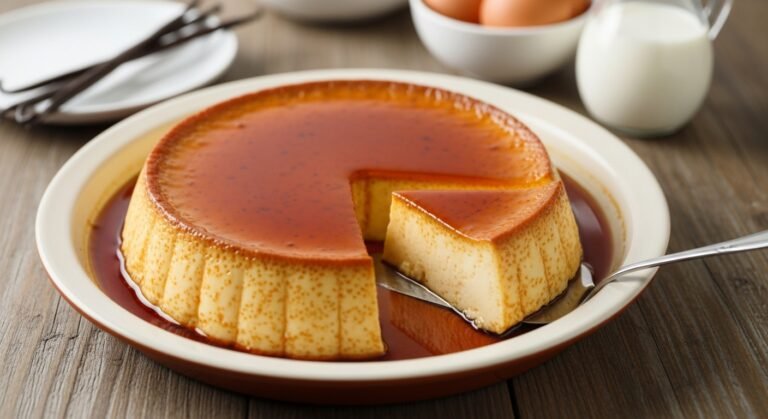
Ingredients
Scale
For the Caramel:
- 1 cup (200g) granulated sugar
- ¼ cup (60ml) water
- 1 tablespoon light corn syrup (optional, helps prevent crystallization)
For the Custard:
- 2 cups (480ml) whole milk
- 1 cup (240ml) heavy cream
- ¾ cup (150g) granulated sugar
- 5 large eggs
- 2 large egg yolks
- 2 teaspoons pure vanilla extract
- ⅛ teaspoon salt
Instructions
- Prepare your molds: Before starting the caramel, have your six 6-ounce ramekins ready and nearby. Caramel hardens quickly, so you need to work fast once it’s ready. Place the ramekins on a rimmed baking sheet for easy handling.
- Cook the caramel: In a medium heavy-bottomed saucepan, combine 1 cup sugar, water, and corn syrup if using. Stir gently to combine, making sure all the sugar is moistened. Place over medium heat and bring to a boil without stirring. Once boiling, stop stirring completely—swirl the pan occasionally if needed for even cooking. Cook for 8-12 minutes until the caramel turns a deep amber color (think the color of an old penny). Watch carefully in the final minutes as it can go from perfect to burned quickly. The caramel should smell nutty and complex, not acrid or burnt.
- Divide the caramel: As soon as the caramel reaches the right color, immediately remove from heat. Working quickly but carefully (caramel is extremely hot), pour about 2-3 tablespoons into each ramekin, tilting each one to coat the bottom evenly. Don’t worry if it’s not perfectly even—it will melt during baking and unmolding. Set aside to harden while you make the custard.
Make the Custard:
- Heat the dairy: Preheat your oven to 325°F (163°C). In a medium saucepan, combine milk and cream. Heat over medium heat until it just begins to steam and tiny bubbles form around the edges (about 180°F). Don’t let it boil. Remove from heat and let cool slightly for 5 minutes.
- Mix eggs and sugar: In a large mixing bowl, whisk together eggs, egg yolks, and ¾ cup sugar until smooth and well combined but not foamy. You want to mix them thoroughly but avoid creating too many air bubbles. Whisk for about 1 minute until the mixture is pale and slightly thickened.
- Temper the eggs: This is a crucial step. Slowly pour about ½ cup of the warm milk mixture into the egg mixture while whisking constantly. This gradually raises the temperature of the eggs without scrambling them. Then slowly pour in the remaining warm milk mixture, whisking continuously. Add vanilla extract and salt, and whisk to combine.
- Strain the custard: Pour the entire custard mixture through a fine-mesh strainer into a large measuring cup or bowl with a pouring spout. This removes any bits of cooked egg and foam, ensuring your custard is perfectly smooth. Press gently with a spoon to push everything through.
- Fill the ramekins: Carefully divide the strained custard among the caramel-lined ramekins, filling each about three-quarters full. If you see any bubbles on the surface, gently skim them off with a spoon or pop them with a toothpick for the smoothest finish.
Bake in Water Bath:
- Prepare the water bath: Place a folded kitchen towel in the bottom of a large roasting pan (this prevents the ramekins from sliding and insulates them). Arrange the filled ramekins on the towel. Place the roasting pan on the oven rack, then carefully pour hot water into the pan until it comes halfway up the sides of the ramekins. The water bath ensures gentle, even cooking that prevents curdling.
- Bake: Bake for 40-50 minutes until the custards are just set but still slightly jiggly in the center when gently shaken. They should wobble like Jell-O but not slosh like liquid. The edges should be set, and the center should be just barely firm. A thermometer inserted in the center should read 170-175°F. Don’t overbake, or the custard will be grainy instead of silky.
- Cool: Carefully remove the roasting pan from the oven. Let the custards sit in the water bath for 10 minutes, then carefully remove each ramekin from the water using tongs or oven mitts. Place on a wire rack and let cool to room temperature, about 1 hour. Once cooled, cover each ramekin with plastic wrap and refrigerate for at least 4 hours or preferably overnight. The custards need this chilling time to fully set and develop flavor.
Unmold and Serve:
- Unmold the custards: When ready to serve, run a thin knife or small offset spatula around the edge of each custard to loosen it from the ramekin. Place a dessert plate upside down over the ramekin, then quickly but confidently flip both over together. Give the ramekin a gentle shake if needed, and the custard should slide out onto the plate with the caramel sauce pooling around it. If it doesn’t release immediately, let it sit for a minute—gravity will do the work.
Notes
- Caramel color is key: Don’t undercook your caramel. Pale caramel tastes simply sweet, while properly cooked deep amber caramel has complex, slightly bitter notes that balance the sweet custard. Look for the color of an old penny or dark honey.
- Water bath is non-negotiable: Never skip the water bath. It’s what creates the silky texture and prevents the eggs from curdling or developing holes.
- Make ahead for best results: This dessert actually improves with time. The flavors meld and the texture becomes even silkier after 24 hours in the refrigerator.
- Room temperature eggs: Take eggs out of the refrigerator 30 minutes before using for easier mixing and more even cooking.
- Don’t overbake: Slightly underdone is better than overdone. The custard will continue to set as it cools.
- Prep Time: 20 minutes
- Cook Time: 45 minutes
- Category: Desert
- Method: Baking (Water Bath)
- Cuisine: French
- Diet: Gluten Free
Nutrition
- Serving Size: 1 custard (1/6 of recipe)
- Calories: 385
- Sugar: 48g
- Sodium: 130mg
- Fat: 16g
- Saturated Fat: 9g
- Unsaturated Fat: 6g
- Trans Fat: 0g
- Carbohydrates: 52g0
- Fiber: 0g
- Protein: 9g
- Cholesterol: 235mg