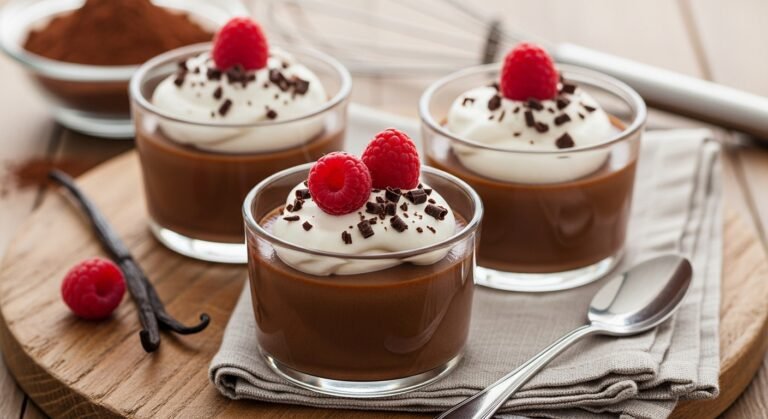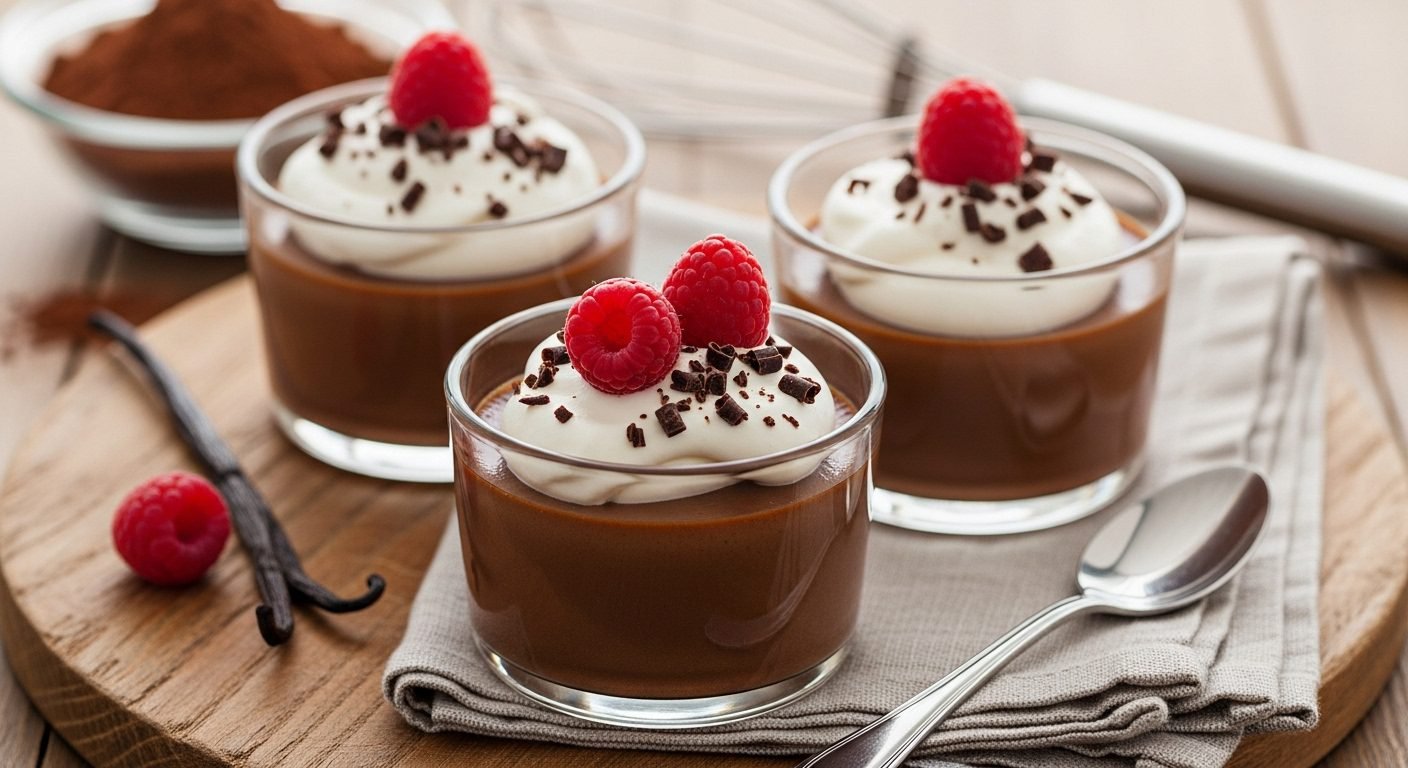
Decadent Chocolate Pot de Crème Recipe – French Chocolate Custard Dessert

Chocolate Pot de Crème is a luxuriously rich French chocolate custard that’s silky, intensely chocolate-flavored, and elegantly simple. This classic French dessert translates to “pot of cream,” which perfectly describes its velvety texture that’s somewhere between pudding and mousse—but far more sophisticated than either. Made with just a handful of premium ingredients, including high-quality chocolate, cream, eggs, and vanilla, Pot de Crème delivers a deeply satisfying chocolate experience that melts on your tongue.
This elegant dessert is perfect for intimate dinner parties, romantic date nights, holiday celebrations, or any time you want to impress guests with minimal effort. Despite its fancy French name and restaurant-quality taste, Pot de Crème is surprisingly straightforward to make at home. It’s also wonderfully make-ahead friendly, making it an ideal choice when you’re entertaining and want a show-stopping dessert that’s already prepared. Served in individual ramekins or elegant cups, these chocolate custards look as beautiful as they taste.
History / Background
Pot de Crème has been a cornerstone of French patisserie since the 17th century, originating in the royal kitchens of France during the reign of Louis XIV. The dessert was originally created as a way to showcase the richness of cream and the luxury of chocolate, which was still a relatively rare and expensive ingredient imported from the Americas at that time. The name comes from the special covered porcelain cups (pots de crème) traditionally used to bake and serve these custards, which helped retain moisture during baking and kept the custard perfectly smooth.
The classic preparation method involves gently baking the custard in a water bath, a technique the French call “bain-marie,” which ensures even, gentle cooking that prevents curdling and creates that signature silky texture. This technique dates back to ancient alchemy and was adapted by French pastry chefs to create the most refined desserts.
While Pot de Crème can be made in various flavors—vanilla, coffee, caramel, or even savory versions—chocolate remains the most beloved and iconic variation. French chocolatier and pastry chefs elevated the dessert to an art form, using the finest dark chocolate to create an intense, sophisticated flavor that’s not overly sweet but deeply satisfying.
The dessert gained popularity beyond France in the mid-20th century when French cuisine became synonymous with fine dining worldwide. Today, Chocolate Pot de Crème appears on menus at upscale restaurants and bistros across America, but it remains wonderfully accessible for home cooks who want to bring a taste of French elegance to their own tables. Unlike elaborate French pastries that require years of training, Pot de Crème relies on quality ingredients and simple technique to achieve spectacular results.
Why You’ll Love This Recipe
This Chocolate Pot de Crème recipe is about to become your secret weapon for effortless entertaining, and here’s why: it delivers Michelin-star quality with surprisingly simple techniques. You’ll look like a professional pastry chef, but you’ll know how easy it actually was to make. The result is pure chocolate bliss—rich, smooth, and intensely satisfying.
Here’s what makes this recipe exceptional:
- Restaurant-quality results – Tastes like a $15 dessert from a French bistro
- Intensely chocolate – Real chocolate creates deep, complex flavor
- Silky smooth texture – Melts on your tongue like chocolate velvet
- Make-ahead friendly – Actually tastes better when made 1-2 days in advance
- Minimal active time – Just 20 minutes of hands-on work
- Impressive presentation – Individual servings look elegant and sophisticated
- Naturally gluten-free – Perfect for guests with dietary restrictions
- Customizable richness – Adjust chocolate intensity to your preference
- Small batch dessert – Perfect portions that satisfy without overwhelming
- No special equipment needed – Basic kitchen tools get the job done
- Fool-proof technique – Hard to mess up if you follow the steps
- Sophisticated yet comforting – Elegant enough for special occasions, comforting enough for a Tuesday night
Ingredient Notes
Dark Chocolate (60-70% cacao): The star of this dessert, high-quality chocolate makes all the difference. Choose chocolate you’d enjoy eating on its own—if it tastes good as a bar, it’ll taste even better in this custard. Dark chocolate in the 60-70% range provides the perfect balance of intense chocolate flavor without being too bitter. Brands like Ghirardelli, Lindt, Valrhona, or Guittard work beautifully. Avoid chocolate chips, which contain stabilizers that prevent smooth melting. Look for bars or baking chocolate in the baking aisle.
Heavy Cream: The cream provides the luxurious, velvety texture that makes Pot de Crème so special. Heavy whipping cream (with 36-40% fat content) is essential—don’t substitute with half-and-half or milk, as you need that fat content for the proper richness and mouthfeel. The cream also helps carry the chocolate flavor across your palate and creates that signature silky texture.
Whole Milk: Adding milk to the cream provides just enough balance to keep the dessert from being overwhelmingly heavy. Whole milk (3.5% fat) is ideal because it adds body without diluting the richness too much. You can use 2% milk in a pinch, but the custard will be slightly less creamy.
Egg Yolks: The yolks are what transform liquid into custard. Their proteins coagulate when gently heated, creating structure while their fat content adds richness and creates that smooth, creamy texture. Use large eggs at room temperature for best results. The yolks also give the custard a beautiful color and add depth of flavor.
Granulated Sugar: Sugar sweetens the dessert while also affecting texture by interfering with protein bonds in the eggs, creating a more tender custard. The amount of sugar can be adjusted based on the bitterness of your chocolate—darker chocolate needs slightly more sugar for balance.
Pure Vanilla Extract: Vanilla enhances and rounds out the chocolate flavor, adding warmth and depth. Always use pure vanilla extract rather than imitation for the best flavor. The vanilla doesn’t compete with the chocolate but rather makes it taste even more chocolatey.
Salt: A small pinch of salt is a secret weapon in chocolate desserts. It enhances all the flavors, balances sweetness, and makes the chocolate taste richer and more complex. Don’t skip this tiny but mighty ingredient.
Optional: Espresso Powder: Adding a teaspoon of instant espresso powder intensifies the chocolate flavor without making the dessert taste like coffee. It’s a professional pastry chef trick that takes chocolate desserts to the next level.
Equipment Needed
You’ll need some basic kitchen equipment for this recipe:
- Medium heavy-bottomed saucepan – For heating the cream mixture (heavy bottom prevents scorching)
- Large heatproof mixing bowl – For melting chocolate and mixing custard
- Whisk – For combining ingredients smoothly
- Fine-mesh strainer – Essential for removing any bits and achieving ultra-smooth custard
- Liquid measuring cup with pour spout – Makes filling ramekins easier
- Six 4-ounce ramekins or small cups – Traditional Pot de Crème cups, espresso cups, or small mason jars all work
- Large roasting pan or baking dish – Must be deep enough to hold ramekins and hot water
- Kitchen towel – To line the bottom of the roasting pan
- Kettle for boiling water – For the water bath
- Rubber spatula – For scraping and folding
- Measuring cups and spoons – For accurate measurements
- Plastic wrap – For covering custards while chilling
- Optional: kitchen thermometer – For checking cream temperature (should reach 170-180°F)
Print

Chocolate Pot de Crème Recipe
This classic French Chocolate Pot de Crème features intensely rich, silky smooth chocolate custard that’s baked in a gentle water bath for the perfect texture. Made with premium dark chocolate, heavy cream, and egg yolks, this elegant dessert tastes like pure luxury in a cup. Naturally gluten-free and make-ahead friendly, it’s the perfect sophisticated dessert for entertaining or treating yourself to something special.
- Total Time: 5 minutes (plus 3 hours chilling time)
- Yield: 6 servings 1x
Ingredients
Scale- 6 ounces (170g) dark chocolate (60-70% cacao), finely chopped
- 1½ cups (360ml) heavy cream
- ¾ cup (180ml) whole milk
- 5 large egg yolks, at room temperature
- ⅓ cup (65g) granulated sugar
- 1 teaspoon pure vanilla extract
- ⅛ teaspoon salt
- 1 teaspoon instant espresso powder (optional, enhances chocolate flavor)
For Serving (optional):
- Whipped cream
- Chocolate shavings or cocoa powder
- Fresh berries
- Flaky sea salt
Instructions
- Set up your workspace: Preheat your oven to 325°F (163°C). Place six 4-ounce ramekins in a large roasting pan. Fold a kitchen towel and place it in the bottom of the pan beneath the ramekins to prevent them from sliding and to insulate them from direct heat. Bring a kettle of water to a boil and set aside—you’ll need this for the water bath later.
- Chop the chocolate: Finely chop your dark chocolate into small, uniform pieces (about the size of chocolate chips). This ensures even, quick melting. Place the chopped chocolate in a large heatproof bowl and set aside.
Make the Custard:
- Heat the dairy: In a medium heavy-bottomed saucepan, combine heavy cream and whole milk. Place over medium heat and heat until the mixture is steaming and small bubbles form around the edges—it should reach about 170-180°F but not boil. Stir occasionally to prevent a skin from forming. This takes about 5-7 minutes. If using espresso powder, add it to the heating cream and whisk to dissolve.
- Melt the chocolate: As soon as the cream mixture is hot, immediately pour it over the chopped chocolate in the bowl. Let it sit undisturbed for 2 minutes to allow the heat to gently melt the chocolate. After 2 minutes, whisk gently until the chocolate is completely melted and the mixture is smooth and glossy. Start slowly and increase speed as the chocolate melts to avoid creating air bubbles.
- Whisk the egg mixture: In a separate medium bowl, whisk together the egg yolks and sugar for about 1 minute until the mixture is smooth and slightly lighter in color. You want them well combined but not frothy or full of air bubbles. Add the vanilla extract and salt, and whisk to incorporate.
- Temper the eggs: This crucial step prevents scrambled eggs. Slowly drizzle about ½ cup of the warm chocolate mixture into the egg yolks while whisking constantly. This gradually raises the temperature of the eggs without cooking them. Once incorporated, slowly pour the tempered egg mixture back into the bowl with the remaining chocolate mixture, whisking constantly until completely smooth and combined.
- Strain for smoothness: Pour the entire custard mixture through a fine-mesh strainer set over a large measuring cup or bowl with a pour spout. Use a rubber spatula to press the mixture through and scrape the bottom of the strainer. This removes any bits of cooked egg or undissolved chocolate, ensuring perfectly smooth custard. Discard any solids left in the strainer.
Bake the Custards:
- Fill the ramekins: Carefully pour or ladle the strained chocolate custard into the six prepared ramekins, dividing evenly. Fill each about ¾ full, leaving a little room at the top. If you see any bubbles on the surface, gently pop them with a toothpick or skim them off with a spoon for the smoothest finish.
- Create the water bath: Place the roasting pan with the filled ramekins on the oven rack (don’t pull the rack all the way out). Carefully pour the hot water from your kettle into the roasting pan, pouring it around the ramekins (not directly on them) until the water comes halfway up the sides of the ramekins. The water bath ensures gentle, even cooking that creates that signature silky texture.
- Bake: Bake for 25-35 minutes. The custards are done when the edges are set but the centers still jiggle slightly when you gently shake a ramekin—they should wobble like Jell-O, not slosh like liquid. The center should look glossy and slightly loose; it will continue to set as it cools. Don’t overbake, or the custard will be grainy instead of silky. Start checking at 25 minutes.
Cool and Chill:
- Cool in water bath: Carefully remove the roasting pan from the oven. Let the custards sit in the water bath for 10 minutes, then carefully remove each ramekin using tongs or a towel. Place them on a wire rack and let cool to room temperature, about 1 hour.
- Chill: Once cooled to room temperature, cover each ramekin tightly with plastic wrap (press it directly on the surface to prevent a skin from forming, or leave a small gap if you prefer). Refrigerate for at least 3 hours or preferably overnight. The custards need this time to fully set and develop their flavors.
Serve:
- Garnish and enjoy: Remove from the refrigerator 10-15 minutes before serving to take the chill off slightly—this allows the chocolate flavor to be more pronounced. Serve directly in the ramekins, topped with a dollop of whipped cream, chocolate shavings, a few fresh berries, or a tiny pinch of flaky sea salt if desired.
Notes
- Chocolate quality matters: This dessert has few ingredients, so quality makes a significant difference. Choose chocolate you enjoy eating on its own.
- Water bath is essential: Don’t skip this step. It’s what creates the silky texture and prevents the custard from curdling or cracking.
- Don’t overbake: The centers should still jiggle when done. They’ll continue to set during cooling and chilling.
- Temperature matters: Room temperature egg yolks incorporate more smoothly and reduce the risk of curdling.
- Make ahead: These taste even better after 24 hours as the flavors meld and deepen.
- Customize chocolate intensity: Use 60% cacao for a sweeter, milder chocolate flavor, or 70% for a more intense, sophisticated taste.
- Prep Time: 15 minutes
- Cook Time: 30
- Category: Desert
- Method: Baking (Water Bath)
- Cuisine: French
- Diet: Gluten Free
Nutrition
- Serving Size: : 1 pot de crème (1/6 of recipe)
- Calories: 425
- Sugar: 28g
- Sodium: 90mg
- Fat: 32g
- Saturated Fat: 19g
- Unsaturated Fat: 11g
- Trans Fat: 0g
- Carbohydrates: 32g
- Fiber: 2g
- Protein: 6g
- Cholesterol: 215mg
Tips & Variations
White Chocolate Pot de Crème: Substitute white chocolate for dark chocolate, reduce sugar to 2 tablespoons, and add the seeds from one vanilla bean or 1 tablespoon of vanilla extract. White chocolate is sweeter, so less added sugar is needed.
Milk Chocolate Version: Use high-quality milk chocolate instead of dark chocolate. Reduce the sugar to 3 tablespoons since milk chocolate is already sweeter. This creates a sweeter, more kid-friendly dessert.
Mocha Pot de Crème: Increase espresso powder to 2 tablespoons for a pronounced coffee flavor that complements the chocolate beautifully. This is perfect for coffee lovers.
Peppermint Chocolate: Add ½ teaspoon peppermint extract along with the vanilla for a refreshing mint-chocolate combination. Top with crushed candy canes during the holidays.
Orange Chocolate: Add 1 tablespoon orange zest to the cream as it heats (strain it out later) and add ½ teaspoon orange extract with the vanilla. The citrus brightens the rich chocolate.
Salted Caramel Chocolate: Swirl 1-2 teaspoons of salted caramel sauce into each ramekin before pouring in the custard. Top with flaky sea salt before serving.
Spiced Chocolate: Add ¼ teaspoon cinnamon and a tiny pinch of cayenne pepper to the cream for a Mexican chocolate-inspired version with subtle warmth.
Raspberry Chocolate: Place 3-4 fresh raspberries in the bottom of each ramekin before pouring in the custard. The fruit creates a surprise layer of tartness.
Lighter Version: Use half heavy cream and half whole milk (instead of cream plus milk) for a slightly less rich but still delicious version. The texture will be a bit less velvety but still wonderful.
Pro Chef Tips
Choose chocolate wisely: Professional pastry chefs know that chocolate quality is paramount in Pot de Crème since it’s the dominant flavor. Use couverture chocolate or premium chocolate bars rather than baking chocolate or chips. The higher cocoa butter content in quality chocolate creates a smoother, more luxurious texture. Taste your chocolate before using it—if it’s not delicious on its own, it won’t magically become delicious in the dessert.
Temperature control is everything: The key to silky custard without a grainy texture is controlling heat at every stage. Heat your cream mixture to 170-180°F—hot enough to melt chocolate but not boiling. When tempering eggs, add the hot mixture slowly in a steady stream while whisking constantly. Bake at a low temperature (325°F) in a water bath. This gentle approach prevents the proteins in eggs from seizing up and creating a grainy texture.
Strain without exception: Even experienced pastry chefs always strain custard mixtures. This simple step removes any bits of cooked egg, undissolved chocolate, or foam, guaranteeing a perfectly smooth result. Press the mixture through with a spatula and scrape the underside of the strainer to get every last drop of silky custard.
Master the wobble test: Professional bakers check doneness by gently shaking a ramekin. The custard should jiggle in the center like firm Jell-O—it should move as one cohesive mass, not slosh like liquid or sit completely still. The center should look glossy and slightly loose. When you touch the center gently, your finger should leave an impression that slowly springs back.
Bloom your espresso powder: For the most intense coffee flavor, professional pastry chefs “bloom” espresso powder by mixing it with a small amount of hot cream and letting it sit for a minute before whisking into the rest of the mixture. This awakens the coffee aromatics and intensifies the flavor.
Prevent water contamination: When creating your water bath, be extremely careful not to splash water into the custards. Even a single drop can ruin the texture. Pour slowly and steadily around the ramekins, never directly over them. Some chefs cover the entire pan with foil to prevent any steam from condensing and dripping into the custards.
Overnight is optimal: While you can serve these after 3-4 hours of chilling, overnight aging allows the flavors to fully develop and meld. The chocolate flavor becomes more rounded and complex, and the texture becomes even silkier. Professional kitchens always make these at least 24 hours ahead.
Common Mistakes to Avoid
Mistake #1: Using low-quality chocolate or chocolate chips. This is the most critical mistake. Chocolate chips contain stabilizers that prevent smooth melting and create a grainy texture. Compound chocolate or imitation chocolate lacks cocoa butter and will never achieve that silky mouthfeel. Invest in good-quality chocolate bars—the difference in taste and texture is dramatic. If you wouldn’t enjoy eating the chocolate on its own, don’t use it in this recipe.
Mistake #2: Adding the hot cream mixture to eggs too quickly. Dumping hot cream into eggs without proper tempering will give you sweet scrambled eggs instead of smooth custard. The key is to add the hot mixture in a slow, steady stream while whisking constantly. This gradually raises the temperature of the eggs without shocking them. Take your time with this step—rushing it is the most common reason for lumpy custard.
Mistake #3: Skipping the water bath or not using enough water. Some home cooks skip the water bath to save time or because it seems fussy, but it’s absolutely essential for Pot de Crème. The water insulates the delicate custard, ensuring gentle, even cooking. Without it, the edges will overcook and become rubbery while the centers remain undercooked. The water should come halfway up the ramekins—if you skimp, you won’t get the insulating effect.
Mistake #4: Overbaking the custards. This is the second most common mistake. Overbaked custard becomes grainy, develops a skin on top, and loses that signature silky texture. Remember that custard continues to cook from residual heat even after leaving the oven, so remove it when the centers still jiggle. It should move like Jell-O when you gently shake a ramekin. If it looks completely set and doesn’t move at all, it’s already overbaked.
Mistake #5: Serving too cold. While Pot de Crème must be chilled to set properly, serving it straight from the refrigerator mutes the chocolate flavor. The cold temperature suppresses taste receptors on your tongue, making the dessert taste less intensely chocolate. Remove custards from the refrigerator 10-15 minutes before serving to take the chill off slightly. You’ll be amazed at how much more flavorful they taste at cool room temperature.
Storage & Meal Prep
Refrigerator Storage: Chocolate Pot de Crème stores beautifully in the refrigerator for up to 4 days when properly covered. Keep them in their ramekins and cover each one tightly with plastic wrap. Press the wrap directly onto the surface of the custard to prevent a skin from forming, or leave a small gap if you prefer (a thin skin won’t affect the texture underneath). The flavor actually improves over the first 24-48 hours as it sits, making this an ideal make-ahead dessert.
Preventing Skin Formation: If you’re bothered by the skin that can form on top of chocolate custards, press plastic wrap directly onto the surface of each custard while it’s still warm (before chilling). This prevents air exposure and keeps the top perfectly smooth. Remove the plastic before serving and the surface will be glossy and pristine.
Serving After Storage: Always remove Pot de Crème from the refrigerator 10-15 minutes before serving to bring them to cool room temperature. This allows the chocolate flavor to fully bloom and creates a better eating experience. They should be cool but not cold.
Batch Cooking: This recipe is easily doubled or even tripled for larger gatherings. The custards keep well for several days, so you can make a large batch and serve them over multiple days without any loss in quality.
Make-Ahead & Freezer Notes
Make-Ahead Instructions: Chocolate Pot de Crème is one of the best make-ahead desserts you can prepare. In fact, it actually tastes better when made 1-2 days in advance. The flavors meld and deepen, and the texture becomes even silkier. You can make these up to 4 days before serving without any quality loss.
For optimal make-ahead planning, bake your custards 1-3 days before your event. Cool them completely, cover tightly with plastic wrap, and refrigerate. On the day you’re serving, simply remove them from the refrigerator 10-15 minutes before dessert time, add any garnishes you like, and serve. This means zero stress or last-minute preparation when you’re entertaining.
Freezing: Unlike many custards, Chocolate Pot de Crème can be frozen with reasonable success, though the texture is slightly affected. To freeze, prepare the custards completely and chill them until fully set. Wrap each ramekin tightly in plastic wrap, then wrap again in aluminum foil to prevent freezer burn. Freeze for up to 1 month. Thaw overnight in the refrigerator before serving—never thaw at room temperature. The texture may be slightly less silky than fresh, but the flavor remains excellent.
Component Prep: If you want to minimize day-of work, you can prepare components in advance. Chop your chocolate and measure all ingredients up to 2 days ahead. Store chopped chocolate in an airtight container at room temperature. Separate eggs and keep yolks in an airtight container in the refrigerator for up to 2 days.
Best Serving Temperature: These should always be served chilled or at cool room temperature, never warm. Remove from refrigerator 10-15 minutes before serving for optimal flavor.
Serving Suggestions
Chocolate Pot de Crème is rich and luxurious, so it works best after lighter meals and paired with complementary flavors:
Classic Garnishes: A small dollop of lightly sweetened whipped cream, shaved dark chocolate or chocolate curls, a dusting of cocoa powder, a few fresh raspberries or strawberries, a sprig of fresh mint, candied orange peel, or a tiny pinch of flaky sea salt (which enhances the chocolate flavor beautifully).
Beverage Pairings: Serve with espresso, French press coffee, or a coffee drink like cappuccino or café au lait. For wine pairings, try port, late-harvest dessert wines, or even a full-bodied red wine like Cabernet Sauvignon. For non-alcoholic options, serve with hot chocolate (yes, chocolate on chocolate!), chai tea, or sparkling water with a twist of orange.
After What Meal: This decadent dessert is best served after lighter main courses so it doesn’t feel too heavy. It pairs beautifully following French dishes like bouillabaisse, coq au vin, or roasted chicken. It’s also lovely after grilled fish, roasted vegetables, or salad-based meals. Because it’s so rich, keep dinner courses relatively light.
Textural Contrasts: Serve with crispy cookies like biscotti, pirouettes, or shortbread for textural contrast. The crunch plays beautifully against the silky custard. You could also serve with delicate wafer cookies or langue de chat biscuits.
French Café Presentation: For an authentic French café experience, serve your Pot de Crème with a small cup of strong espresso on the side and a glass of water. This is traditional in French bistros.
Seasonal Touches: In fall and winter, add warming spices like cinnamon or a cinnamon stick garnish. In spring, serve with fresh berries. In summer, add a small scoop of vanilla ice cream on the side for contrast. During holidays, top with crushed candy canes or peppermint whipped cream.
FAQs Section
Can I make this without a water bath?
While technically you could bake without a water bath, I strongly advise against it. The water bath (bain-marie) is essential for creating the signature silky texture of Pot de Crème. It provides gentle, even heat that prevents the eggs from curdling and ensures smooth, creamy custard. Without it, you’ll get overcooked, rubbery edges and an undercooked center. The effort of setting up a water bath is minimal and absolutely worth it for the results.What’s the difference between Pot de Crème and chocolate mousse?
While both are chocolate desserts, they’re quite different. Mousse is aerated with whipped cream or egg whites, creating a light, fluffy texture. Pot de Crème is a baked custard made with egg yolks and cream, creating a dense, silky texture. Mousse has a cloud-like consistency, while Pot de Crème is smooth and spoonable, more like a firm pudding. Pot de Crème is also richer and more intensely chocolate.Can I use milk chocolate instead of dark chocolate?
Yes, but you’ll need to adjust the sugar. Milk chocolate is much sweeter than dark chocolate, so reduce the sugar to 3 tablespoons (instead of ⅓ cup) or the dessert will be too sweet. Keep in mind that milk chocolate creates a sweeter, less sophisticated flavor profile. It’s delicious, just different—more like a chocolate pudding and less like an elegant French dessert.Why is my custard grainy instead of smooth?
Grainy texture usually indicates one of two issues: the eggs were cooked too quickly (overheated) or the custard was overbaked. Make sure you temper the eggs slowly by adding hot cream gradually while whisking constantly. Also ensure you’re baking at 325°F in a proper water bath and removing the custards when they still jiggle in the center. Grainy texture can also result from using poor-quality chocolate with low cocoa butter content.Can I make these dairy-free?
Yes, with some substitutions. Use full-fat coconut cream in place of heavy cream and coconut milk or almond milk in place of dairy milk. Make sure to use dairy-free dark chocolate (most dark chocolate is naturally dairy-free, but check labels). The texture will be slightly different—a bit firmer and less rich—but still delicious. The coconut flavor will be subtle but present.How do I know when they’re done baking?
The best test is the jiggle test. Gently shake one of the ramekins—the custard should jiggle like Jell-O, moving as one cohesive mass with the center slightly looser than the edges. It should not slosh like liquid or sit completely still. The center should look glossy and slightly wet. Insert a thermometer in the center—it should read 170-175°F. Remember that custard continues to set as it cools, so err on the side of slightly underdone.Can I make one large Pot de Crème instead of individual servings?
Yes! Use an 8-inch round baking dish or similar size dish. Pour all the custard into the dish and bake in the water bath for 35-45 minutes (longer than individual ramekins because of the volume). Check for doneness the same way. To serve, spoon portions directly from the dish rather than unmolding. While less traditional, it’s equally delicious and saves time.Conclusion
Congratulations—you’re now equipped to make one of France’s most beloved desserts right in your own kitchen! Chocolate Pot de Crème might sound fancy and intimidating, but as you’ve seen, it’s actually wonderfully straightforward and forgiving. The combination of premium chocolate, rich cream, and gentle baking creates a dessert that’s pure luxury in every spoonful.
The beauty of this recipe is that it looks and tastes like something from a five-star restaurant, but it uses simple techniques and ingredients you can find at any grocery store. Plus, it’s make-ahead friendly, which means you can prepare it days in advance and simply pull it from the refrigerator when you’re ready to serve. No stress, all elegance!
I hope you absolutely love making and serving these Chocolate Pot de Crème. There’s something so satisfying about spooning into that silky chocolate custard and watching your guests’ faces light up with delight. It’s one of those special desserts that makes everyone feel pampered and appreciated.
If you try this recipe, I’d be thrilled to hear about your experience! Leave a comment below sharing how it turned out, any variations you tried, or questions you might have. And if this recipe made you feel like a French pastry chef (which I’m sure it will), please share it on Pinterest so other chocolate lovers can discover this wonderful dessert too.
Happy baking, and here’s to bringing a taste of France into your home! 🍫✨