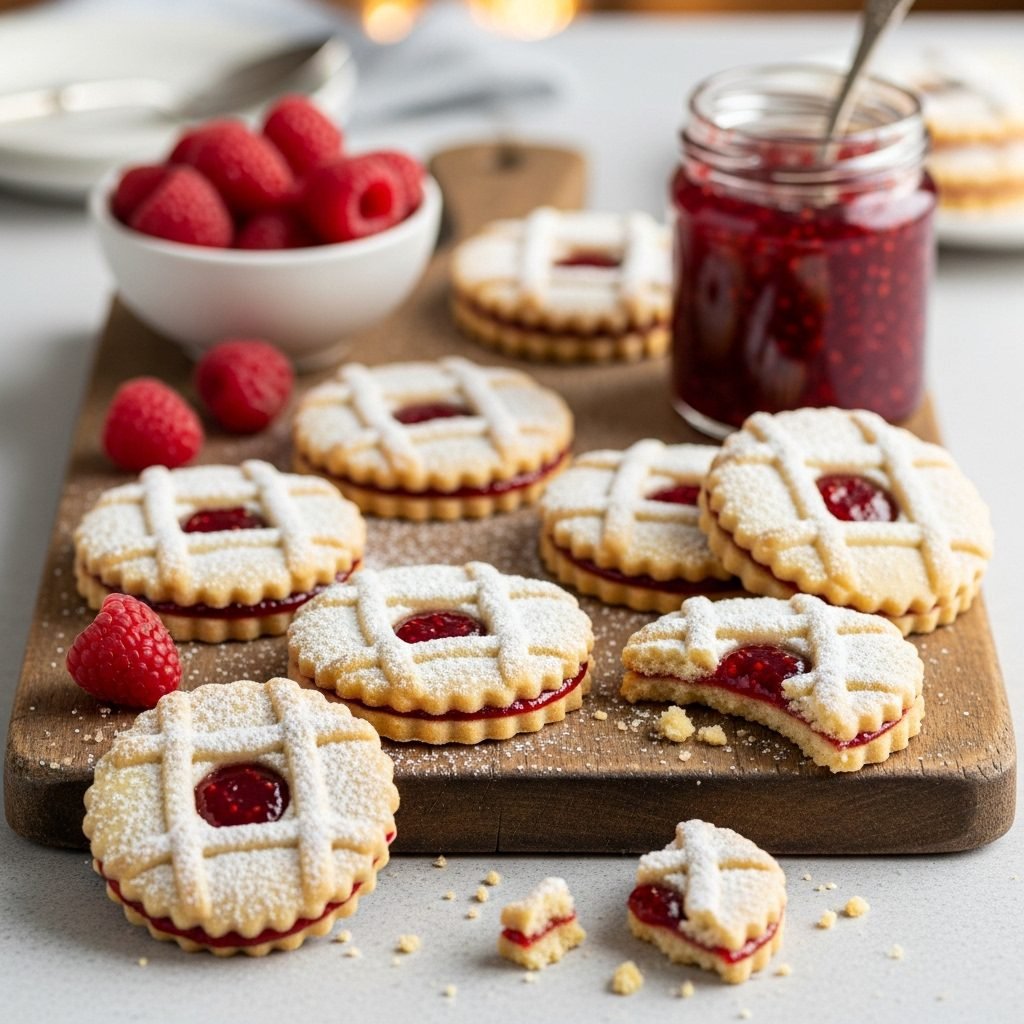
Raspberry Linzer Cookies Recipe – Buttery, Jammy, and Perfect for Any Occasion

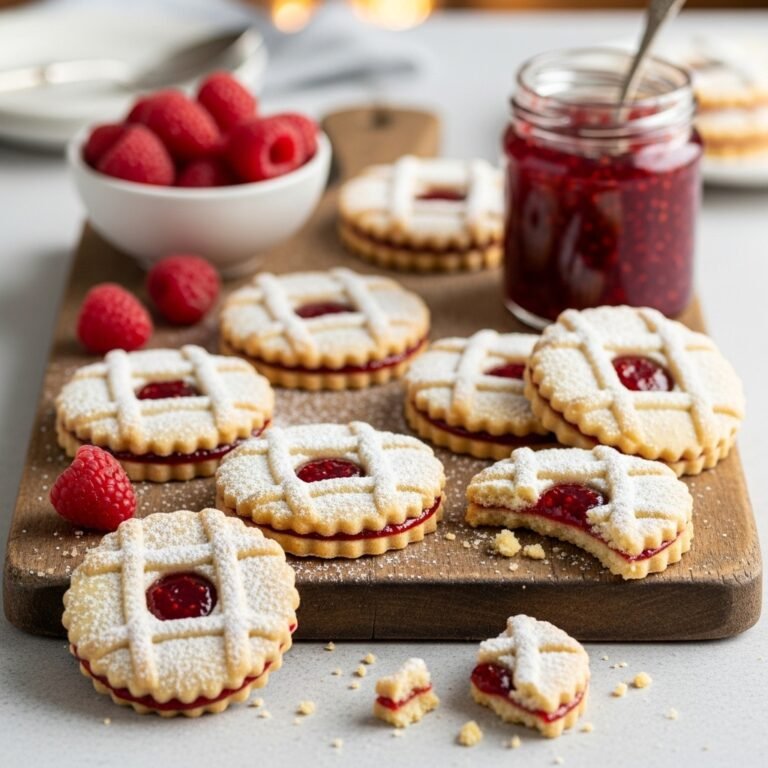
Raspberry Linzer Cookies are delicate, buttery sandwich cookies filled with vibrant raspberry jam and dusted with powdered sugar. These elegant European-style treats feature a shortbread-like base made with ground almonds or hazelnuts, giving them a rich, nutty flavor and tender crumb. The signature cutout window on top reveals the jewel-toned jam filling, making them as beautiful as they are delicious.
These cookies are a holiday favorite, especially during Christmas cookie exchanges, but they’re absolutely perfect year-round for afternoon tea, bridal showers, Valentine’s Day celebrations, or any time you want to impress guests with something homemade and special. The combination of buttery almond cookie and tart-sweet raspberry jam creates an irresistible flavor balance that keeps people reaching for just one more.
What makes Linzer cookies particularly wonderful is their versatility. You can make them ahead, they ship beautifully for gift-giving, and they stay fresh for days when stored properly. Plus, that gorgeous cutout design makes them instantly recognizable and Instagram-worthy, which is why they’re such a Pinterest favorite among home bakers looking to elevate their cookie game.
History / Background
Linzer cookies have a fascinating history that dates back to the beautiful Austrian city of Linz, which sits along the Danube River. These delightful sandwich cookies are actually inspired by the Linzer torte, which is considered one of the oldest known cake recipes in the world, with written documentation dating back to the 1650s.
The original Linzer torte was a lattice-topped tart filled with black currant preserves and made with a rich dough containing ground nuts, spices like cinnamon and cloves, and lemon zest. Austrian bakers eventually transformed this beloved dessert into smaller, more portable cookie form, creating what we now know as Linzer cookies or Linzer Augen (which means “Linzer eyes” in German, referring to the cutout windows).
The cookie version became popular throughout Central Europe, particularly in Austria, Germany, and Switzerland, where they became a staple at Christmas markets and holiday celebrations. Each region developed its own variations, with some using hazelnuts instead of almonds, or apricot jam instead of raspberry.
When European immigrants brought their baking traditions to America in the 19th and early 20th centuries, Linzer cookies came along for the journey. They quickly became a beloved part of American holiday baking traditions, especially in areas with strong German and Austrian heritage. Today, these elegant cookies are a fixture at Christmas cookie exchanges across the United States, though their appeal has expanded well beyond the holiday season.
The raspberry version has become particularly popular in America, where the bright red jam creates a festive appearance perfect for celebrations. The contrast between the pale, nutty cookie and the vibrant filling makes these treats as visually stunning as they are delicious.
Why You’ll Love This Recipe
This Raspberry Linzer Cookie recipe strikes the perfect balance between impressive presentation and achievable home baking. While these cookies look like they came from a fancy European bakery, they’re surprisingly straightforward to make with techniques that any home baker can master.
Here’s why this recipe will become one of your favorites:
- Bakery-quality results at home – These cookies look professional and taste even better than store-bought versions
- Make-ahead friendly – The dough can be prepared days in advance, and baked cookies stay fresh for over a week
- Perfect for gifting – They ship beautifully and look gorgeous packaged in boxes or tins
- Customizable flavors – While raspberry is classic, you can use any jam or preserve you love
- Impressive but accessible – Despite their elegant appearance, these cookies use simple techniques and common ingredients
- Freezer-friendly – Both the dough and baked cookies freeze exceptionally well
- Crowd-pleaser – The combination of buttery almond cookie and fruity jam appeals to almost everyone
- Perfect texture – The addition of ground nuts creates a tender, melt-in-your-mouth cookie that’s never dry
- Beautiful presentation – Those cutout windows make every cookie a little work of art
Whether you’re an experienced baker or just starting your cookie-making journey, this recipe will give you confidence and delicious results every single time.
Ingredient Notes
Understanding your ingredients is the key to baking success, so let’s talk about what goes into these beautiful cookies and why each component matters.
All-Purpose Flour – Forms the structure of the cookie. For best results, spoon the flour into your measuring cup rather than scoking it directly from the bag, which can pack in too much flour and make cookies dense.
Ground Almonds or Almond Flour – This is what makes Linzer cookies special. The ground almonds add moisture, richness, and that characteristic tender texture. You can substitute with ground hazelnuts for a more traditional Austrian version, or use finely ground pecans or walnuts. If you have a nut allergy, you can omit the nuts and increase the flour, though the texture will be different.
Unsalted Butter – Always use unsalted butter in baking so you can control the salt level. The butter should be softened to room temperature for easy creaming. It provides richness and that melt-in-your-mouth quality.
Granulated Sugar – Sweetens the dough and helps create a tender crumb through the creaming process with butter.
Egg Yolks – Using just the yolks (rather than whole eggs) creates an extra-tender, rich cookie with a beautiful golden color. Save those egg whites for meringues or an omelet.
Vanilla Extract – Adds warmth and depth to the flavor. Use pure vanilla extract, not imitation, for the best taste.
Lemon Zest – A traditional Linzer ingredient that adds brightness and complexity. The citrus notes complement both the almond and raspberry beautifully.
Salt – Just a pinch enhances all the other flavors and balances the sweetness.
Ground Cinnamon – A subtle warm spice that’s traditional in Linzer cookies. Some recipes also include a tiny pinch of cloves or nutmeg.
Raspberry Jam or Preserves – The star filling. Seedless jam is easier to work with and looks smoother, but preserves with seeds are more traditional and have better flavor. Choose a high-quality jam with real fruit as the first ingredient. You can also use apricot, strawberry, blackberry, or red currant jam.
Powdered Sugar – For dusting the finished cookies, which adds sweetness and makes them look absolutely beautiful. Make sure to dust them just before serving for the prettiest presentation.
Equipment Needed
Having the right tools makes the baking process smooth and enjoyable. Here’s what you’ll need to make perfect Linzer cookies:
- Stand mixer or hand mixer – For creaming butter and sugar and mixing the dough
- Mixing bowls – At least two, one large and one medium
- Measuring cups and spoons – Accurate measurements are crucial in baking
- Fine mesh sieve or sifter – For sifting powdered sugar over finished cookies
- Rolling pin – For rolling out the cookie dough evenly
- Cookie cutters – You’ll need two sizes: a 2 to 2.5-inch round or fluted cutter for the base, and a smaller cutter (about 3/4 to 1-inch) for the center cutouts. Hearts, stars, and circles are most popular
- Baking sheets – Two or three, preferably light-colored (dark pans can cause over-browning)
- Parchment paper or silicone baking mats – Prevents sticking and makes cleanup easy
- Plastic wrap – For wrapping dough while it chills
- Cooling racks – Essential for cooling cookies properly
- Small offset spatula or butter knife – For spreading jam on the cookie bases
- Small spoon or piping bag – For filling the cookies with jam
Print

Raspberry Linzer Cookies Recipe
Buttery almond sandwich cookies with a ruby-red raspberry jam filling and delicate powdered sugar dusting. These elegant European-style treats are perfect for holidays, special occasions, or any time you want an impressive homemade cookie.
- Total Time: 2 hours 15 minutes
- Yield: 24 sandwich cookies (48 individual cookies) 1x
Ingredients
ScaleFor the Cookies:
- 2 cups all-purpose flour
- 1 cup ground almonds or almond flour (blanched almonds work best)
- 1/2 teaspoon ground cinnamon
- 1/4 teaspoon salt
- 1 cup (2 sticks) unsalted butter, softened to room temperature
- 2/3 cup granulated sugar
- 2 large egg yolks
- 1 teaspoon vanilla extract
- 1 teaspoon lemon zest (from about 1 lemon)
For Assembly:
- 3/4 to 1 cup seedless raspberry jam (or raspberry preserves)
- 1/2 cup powdered sugar (for dusting)
Instructions
- Prepare the dry ingredients: In a medium bowl, whisk together the flour, ground almonds, cinnamon, and salt. Set aside.
- Cream the butter and sugar: In a large mixing bowl or the bowl of your stand mixer, beat the softened butter and granulated sugar together on medium speed for 3-4 minutes until light and fluffy. Scrape down the sides of the bowl as needed.
- Add wet ingredients: Beat in the egg yolks one at a time, mixing well after each addition. Add the vanilla extract and lemon zest, and mix until fully incorporated.
- Combine wet and dry: Reduce mixer speed to low and gradually add the flour mixture to the butter mixture. Mix just until the dough comes together and no flour streaks remain. Don’t overmix.
- Chill the dough: Divide the dough in half and shape each half into a flat disk. Wrap each disk tightly in plastic wrap and refrigerate for at least 1 hour or up to 3 days. The dough needs to be firm enough to roll out without becoming too soft.
- Preheat and prepare: When ready to bake, preheat your oven to 350°F (175°C). Line baking sheets with parchment paper or silicone baking mats.
- Roll out the dough: Working with one disk at a time (keep the other refrigerated), roll the dough out on a lightly floured surface to about 1/8-inch thickness. If the dough becomes too soft, return it to the refrigerator for 10-15 minutes.
- Cut out cookies: Using your larger cookie cutter, cut out as many cookies as possible. Place half of the cookies on your prepared baking sheets, spacing them about 1 inch apart (these will be your bottoms). For the remaining cookies, use your smaller cutter to cut out the centers (these will be your tops with the window).
- Re-roll scraps: Gather the dough scraps, press them together gently, and re-roll to cut more cookies. You can re-roll the dough once or twice, but avoid doing it too many times or the cookies will become tough.
- Bake: Bake for 10-12 minutes, until the cookies are just set and the edges are barely beginning to turn golden. The cookies should still look pale. Don’t overbake or they’ll be dry.
- Cool completely: Let cookies cool on the baking sheet for 5 minutes, then transfer to a wire cooling rack to cool completely. This is important – the cookies must be completely cool before assembling or the jam will make them soggy.
- Prepare the jam: If your raspberry jam is very thick or has large pieces of fruit, warm it gently in the microwave for 15-20 seconds and stir until smooth. This makes it easier to spread.
- Assemble the cookies: Place all the solid bottom cookies (the ones without cutouts) on your work surface. Spoon or pipe about 1 teaspoon of raspberry jam onto the center of each bottom cookie, spreading it gently with the back of a spoon or a small offset spatula. Leave a small border around the edges.
- Add the tops: Dust the cutout cookies (the tops) generously with powdered sugar using a fine mesh sieve. Carefully place each dusted top cookie onto a jam-covered bottom cookie, pressing down very gently to secure.
- Final dusting: Once all cookies are assembled, give them one more light dusting of powdered sugar if desired for an extra beautiful finish.
Notes
- The dough can be made up to 3 days in advance and kept refrigerated, or frozen for up to 3 months.
- If the dough becomes too soft while rolling and cutting, pop it back in the fridge for 10 minutes.
- For neater cookies, use a small offset spatula to loosen cut cookies from the counter before transferring to baking sheets.
- Don’t skip chilling the dough – it prevents spreading and makes the dough much easier to work with.
- If you don’t have ground almonds, pulse whole blanched almonds in a food processor until finely ground (but not a paste).
- These cookies taste even better the day after baking once the flavors have melded together.
- Prep Time: 30 minutes (plus 1 hour chilling time)
- Cook Time: 10-12 minutes per batch
- Category: Desert
- Method: Baking
- Cuisine: Austrian
- Diet: Vegetarian
Nutrition
- Serving Size: 1 sandwich cookie
- Calories: 165
- Sugar: 12g
- Sodium: 45mg
- Fat: 9g
- Saturated Fat: 4.5g
- Unsaturated Fat: 4g
- Trans Fat: 0g
- Carbohydrates: 19g
- Fiber: 1g
- Protein: 2.5g
- Cholesterol: 35mg
Tips & Variations
These cookies are wonderfully adaptable. Here are some delicious ways to customize them to suit your taste or occasion:
Flavor Variations:
- Apricot Linzer Cookies – Use apricot preserves instead of raspberry for a more traditional Austrian version with a mellower, sweeter flavor
- Mixed Berry – Try strawberry, blackberry, or black currant jam for different flavor profiles
- Chocolate Hazelnut – Use ground hazelnuts instead of almonds and fill with Nutella or chocolate hazelnut spread
- Lemon Linzer – Add extra lemon zest to the dough and use lemon curd as the filling for a bright, citrusy twist
- Spiced Version – Increase the cinnamon and add a pinch of ground cloves, nutmeg, or cardamom for a more aromatic cookie
Dietary Modifications:
- Gluten-Free – Replace the all-purpose flour with a 1:1 gluten-free baking flour blend. The almond flour already in the recipe helps with texture
- Vegan – Use vegan butter and replace the egg yolks with 2 tablespoons of aquafaba (chickpea liquid) or a flax egg
- Lower Sugar – Reduce the sugar in the dough to 1/2 cup and use a low-sugar or sugar-free jam
Nut Alternatives:
- Ground hazelnuts create an authentic Austrian flavor
- Finely ground pecans or walnuts work beautifully
- For nut-free cookies, replace the ground almonds with an additional 1 cup of flour and 2 tablespoons of cornstarch (the texture will be different but still delicious)
Shape and Design Ideas:
- Cut squares instead of circles for a modern look
- Use different shaped cutouts for the centers – hearts for Valentine’s Day, stars for Christmas, flowers for spring
- Make mini Linzer cookies using 1-inch cutters for bite-sized treats
- Create a full lattice top instead of a simple cutout for a more traditional Linzer torte appearance
Pro Chef Tips
These professional techniques will take your Linzer cookies from good to absolutely exceptional:
Temperature is everything. Keep your ingredients at the right temperature throughout the process. Room temperature butter creams better with sugar, but the rolled dough needs to stay cold or it will spread during baking. If your kitchen is warm, work in batches and keep half the dough in the fridge while working with the other half.
Use parchment paper when rolling. For easier handling and less mess, roll your dough between two sheets of parchment paper instead of on a floured surface. This eliminates the need for extra flour (which can toughen cookies) and makes transferring cut cookies to baking sheets much simpler. Just peel off the top parchment, cut your shapes, remove the scraps, and slide the parchment with the cut cookies directly onto your baking sheet.
Weigh your flour for consistency. If you have a kitchen scale, weigh your flour instead of measuring by volume. All-purpose flour should be 240 grams for 2 cups. This ensures your dough isn’t too dry or too wet, which directly affects texture.
Chill cut cookies before baking. After cutting your shapes and placing them on baking sheets, pop the entire sheet into the freezer for 10 minutes before baking. This extra chill time helps cookies maintain their shape and prevents spreading, resulting in cleaner edges and more defined cutouts.
Toast your nuts for deeper flavor. Before grinding your almonds, toast them in a 350°F oven for 5-7 minutes until fragrant. Let them cool completely before grinding. This extra step adds incredible depth and a more pronounced almond flavor to your cookies.
Don’t overbake. Linzer cookies should be just barely golden at the edges and still pale on top when you remove them from the oven. They’ll firm up as they cool. Overbaked cookies will be dry and crumbly instead of tender and buttery.
Strain your jam. For the smoothest, most professional-looking filling, press your jam through a fine mesh strainer to remove any seeds or large fruit pieces. Warm the jam slightly before straining to make it easier. This creates a glossy, smooth filling that looks bakery-perfect.
Assemble just before serving for maximum impact. While assembled cookies store well, for the most dramatic presentation, keep the powdered sugar dusting until right before serving. The sugar can absorb moisture from the jam over time, so a fresh dusting just before your guests arrive makes them look absolutely stunning.
Common Mistakes to Avoid
Even experienced bakers can run into issues with these cookies. Here’s how to avoid the most common pitfalls:
Not chilling the dough long enough. If your dough isn’t properly chilled, it will be sticky and difficult to work with, and the cookies will spread too much during baking, losing their shape. Always chill for at least an hour, and if the dough becomes soft while rolling, pop it back in the fridge. Patience here makes all the difference.
Overworking the dough. Once you add the flour to your butter mixture, mix just until combined. Overmixing develops too much gluten, which makes cookies tough instead of tender. Also, limit how many times you re-roll scraps – once or twice is fine, but more than that and the cookies become dense.
Using too much flour when rolling. While you need some flour to prevent sticking, using too much flour on your work surface incorporates extra flour into the dough, making cookies dry and less tender. Use just enough to prevent sticking, and try the parchment paper method mentioned in the pro tips section.
Assembling cookies while they’re still warm. This is a big one. If you fill cookies before they’re completely cool, the jam will make them soggy and they might break. Always wait until cookies are room temperature, and make sure your jam isn’t too hot either.
Overfilling with jam. It’s tempting to add lots of jam, but too much will squish out the sides when you press the cookies together, creating a mess and making them hard to eat. About a teaspoon per cookie is perfect – it should come just to the edge of the cutout window but not overflow.
Dusting with powdered sugar too early. If you dust the tops with powdered sugar and then store them, the sugar will absorb moisture from the jam and dissolve or look wet and clumpy. Either dust just before serving, or store cookies and dust them right when you’re ready to serve or gift them.
Baking at too high a temperature. If your oven runs hot or you bake at a higher temperature, the cookies will brown too quickly on the outside while staying underdone inside. An oven thermometer is a baker’s best friend. These cookies should bake slowly and evenly at 350°F.
Storage & Meal Prep
Proper storage ensures your beautiful Linzer cookies stay fresh and delicious for as long as possible.
Room Temperature Storage: Once completely assembled and the jam has set (give them at least an hour after assembly), store Linzer cookies in an airtight container at room temperature. Place parchment paper or wax paper between layers to prevent sticking. They’ll stay fresh for up to one week this way, though they’re usually gone much sooner!
Preventing Sogginess: The biggest enemy of filled cookies is moisture. To keep your cookies crisp, store them in a container with a tight-fitting lid, and consider placing a small piece of food-safe silica gel packet in the container (not touching the cookies) to absorb excess moisture. Make sure cookies are completely cool and the jam is set before storing.
Storing Components Separately: For maximum freshness and the best texture, you can store the unfilled cookies in an airtight container at room temperature for up to 2 weeks. Store the jam separately in the refrigerator. Assemble the cookies 1-2 days before serving. This method is perfect for preparing for holidays or events when you want everything to taste bakery-fresh.
Refrigerator Storage: While not necessary, you can refrigerate assembled cookies if your kitchen is very warm or humid. Place them in an airtight container with parchment between layers and store for up to 2 weeks. Let them come to room temperature before serving for the best flavor and texture.
Reheating: These cookies don’t require reheating since they’re meant to be enjoyed at room temperature. If they’ve been refrigerated, simply let them sit out for 15-20 minutes before serving.
Reviving Cookies: If your cookies have lost their crispness, you can refresh them briefly in a 300°F oven for 3-4 minutes. Let them cool completely before serving. Don’t do this with powdered sugar already on top, or add fresh powdered sugar after cooling.
Make-Ahead & Freezer Notes
Linzer cookies are one of the best make-ahead cookies you can bake, making them perfect for holiday preparation or whenever you want to spread out your baking over several days.
Freezing the Dough: The cookie dough freezes beautifully for up to 3 months. After making the dough, divide it into disks, wrap each tightly in plastic wrap, then place in a freezer-safe zip-top bag with the date labeled. When ready to use, thaw overnight in the refrigerator before rolling and cutting. You can even roll out the dough, cut the cookies, and freeze them on baking sheets, then transfer frozen cut cookies to bags. Bake directly from frozen, adding 1-2 minutes to the baking time.
Freezing Baked Cookies: Unfilled cookies freeze exceptionally well. Let them cool completely, then arrange in a single layer on a baking sheet and freeze until solid (about an hour). Transfer frozen cookies to freezer-safe containers or bags with parchment paper between layers. They’ll keep for up to 3 months. Thaw at room temperature for about 30 minutes before assembling with jam.
Freezing Assembled Cookies: You can freeze fully assembled Linzer cookies, but don’t dust them with powdered sugar first. Freeze them in airtight containers with parchment between layers for up to 2 months. Thaw overnight in the refrigerator or at room temperature for 1-2 hours, then dust with fresh powdered sugar before serving.
Make-Ahead Timeline:
- 3 months ahead: Make and freeze dough or baked cookies
- 1 week ahead: Bake cookies and store unfilled in airtight containers
- 2-3 days ahead: Assemble cookies with jam, store in airtight containers
- Day of serving: Dust with powdered sugar for the prettiest presentation
Best Thawing Method: For frozen dough or cookies, always thaw in the refrigerator overnight rather than at room temperature. This prevents condensation from making cookies soggy. If you’re in a rush, frozen baked cookies can thaw at room temperature in about an hour.
Holiday Prep Strategy: Many bakers make Linzer cookie dough in early December, freeze it, then bake and assemble cookies in batches throughout the month as gifts or for different gatherings. This spreads out the work and ensures fresh-tasting cookies for every occasion.
Serving Suggestions
Linzer cookies are versatile treats that shine in many different settings. Here’s how to serve them for maximum enjoyment:
Classic Presentation: Arrange Linzer cookies on a pretty serving platter or tiered cake stand with the cutout sides facing up so the raspberry jam windows are visible. The visual effect of those jewel-toned centers is stunning. Garnish the platter with fresh raspberries and a light dusting of powdered sugar for an elegant touch.
With Hot Beverages: These cookies are perfect alongside coffee, tea, or hot chocolate. The buttery richness pairs beautifully with espresso or cappuccino. For tea lovers, try serving them with Earl Grey, English Breakfast, or a delicate jasmine tea. The almond and raspberry flavors complement the tannins in tea wonderfully.
Dessert Platter: Include Linzer cookies as part of a larger dessert spread. They pair beautifully with other European cookies like shortbread, biscotti, or butter cookies. Add some chocolate truffles, fresh fruit, and a small bowl of whipped cream for dipping.
Ice Cream Sandwiches: For a fun twist, use Linzer cookies to make ice cream sandwiches. Skip the jam filling and sandwich vanilla, raspberry, or almond ice cream between two cookies. Roll the edges in sliced almonds for an extra special touch.
With Fresh Fruit: Serve alongside fresh berries – especially raspberries – for a lovely presentation that reinforces the flavor. Add some whipped cream or crème fraîche on the side.
Wine and Cookie Pairing: Linzer cookies pair beautifully with dessert wines. Try them with Moscato d’Asti, late-harvest Riesling, or a light port. The fruity notes in these wines complement the raspberry filling.
Holiday Cookie Boxes: These cookies are perfect for gift-giving. Arrange them in decorative tins or boxes lined with parchment paper, with a ribbon tied around the box. They look professional and ship well without breaking.
Brunch Addition: Add Linzer cookies to your brunch spread. They’re perfect alongside pastries, fresh fruit, and yogurt parfaits. They’re not too heavy for morning eating and add an elegant touch to the table.
Children’s Tea Parties: Kids love the cutout windows and sweet jam filling. Serve with milk or hot chocolate and let them feel fancy with these beautiful treats.
FAQs Section
Can I use store-bought almond flour instead of grinding my own almonds?
Absolutely! Store-bought almond flour (also called almond meal) works perfectly in this recipe and is actually more convenient. Just make sure you’re using blanched almond flour rather than almond flour with skins, as the finer texture creates a more delicate cookie. If your almond flour seems coarse, you can pulse it a few times in a food processor to make it finer, though this isn’t strictly necessary.
Why are my cookies spreading too much during baking?
Cookie spreading is usually caused by dough that’s too warm. Make sure your dough is properly chilled before rolling, and if your kitchen is warm, chill the cut cookies on the baking sheet for 10 minutes before baking. Also check that your butter was softened (not melted) when making the dough, and that you’re measuring flour correctly – too little flour can cause spreading.
Can I make these cookies without a cookie cutter?
Yes! If you don’t have cookie cutters, you can use a drinking glass or jar lid to cut circles. For the center cutouts, use a small bottle cap, piping tip, or even a thimble. You can also cut the cookies into squares with a knife or pizza cutter and use a straw to punch out the center hole. The cookies will taste just as delicious regardless of their shape.
My dough is too crumbly and won’t come together. What should I do?
If your dough seems dry and crumbly, you can add cold water one teaspoon at a time, mixing gently after each addition until the dough comes together. This sometimes happens in dry climates or if you accidentally added too much flour. Another option is to add an extra egg yolk. Alternatively, try pressing and kneading the dough gently with your hands – the warmth can help bring it together.
How do I prevent the jam from making my cookies soggy?
The key is to make sure your cookies are completely cool before assembling, and to use a jam that’s not too thin or watery. High-quality preserves with a thick consistency work best. Don’t overfill the cookies, and make sure there’s a border of cookie around the jam. Storing cookies in an airtight container also helps prevent moisture issues. For the crispest cookies, assemble them no more than 1-2 days before serving.
Can I use a different type of jam?
Definitely! While raspberry is traditional and beautiful, you can use any jam you prefer. Apricot is very traditional in Austria, and strawberry, blackberry, red currant, or even fig jam are all delicious. You can also use lemon curd for a citrus version, or Nutella for a chocolate-hazelnut twist. Just make sure whatever filling you choose isn’t too runny.
Do I have to use nuts in this recipe?
The ground almonds are what give Linzer cookies their characteristic tender texture and nutty flavor, but if you have a nut allergy, you can make a modified version. Replace the ground almonds with an additional 1 cup of all-purpose flour plus 2 tablespoons of cornstarch. The cookies will have a different texture – more like shortbread – but they’ll still be delicious. Just note they won’t be authentic Linzer cookies without the nuts.
Conclusion
There’s something truly magical about Raspberry Linzer Cookies. Maybe it’s the way that bright ruby jam peeks through the delicate cutout window, or how the buttery almond cookie melts on your tongue with each bite. Perhaps it’s the way they make any occasion feel a little more special, or how a plate of these beautiful cookies can brighten someone’s entire day.
Whether you’re baking these for a holiday cookie exchange, packaging them up as heartfelt gifts, serving them at a celebration, or simply treating yourself to something lovely with your afternoon tea, these cookies deliver both in flavor and presentation. The combination of nutty richness, fruity sweetness, and tender texture is simply irresistible.
The best part? Once you’ve made these a few times, the process becomes wonderfully meditative. There’s something deeply satisfying about rolling dough, cutting perfect circles, watching them bake to pale golden perfection, and finally assembling them into those gorgeous sandwich cookies. It’s baking therapy at its finest.
So gather your ingredients, clear some space on your counter, and treat yourself to an afternoon of baking. Your kitchen will smell amazing, your hands will be dusted with flour and powdered sugar, and by the end, you’ll have created something truly beautiful and delicious. These aren’t just cookies – they’re little edible works of art that carry with them centuries of baking tradition.
Happy baking, and I hope these Raspberry Linzer Cookies bring as much joy to your table as they have to mine. Don’t forget to snap a photo before they disappear – because trust me, they won’t last long!
Pin this recipe for later and share your Linzer cookie creations with me on social media – I love seeing your baking adventures!