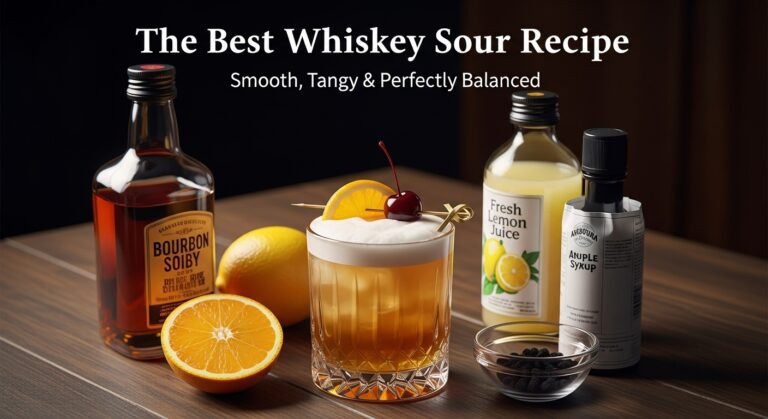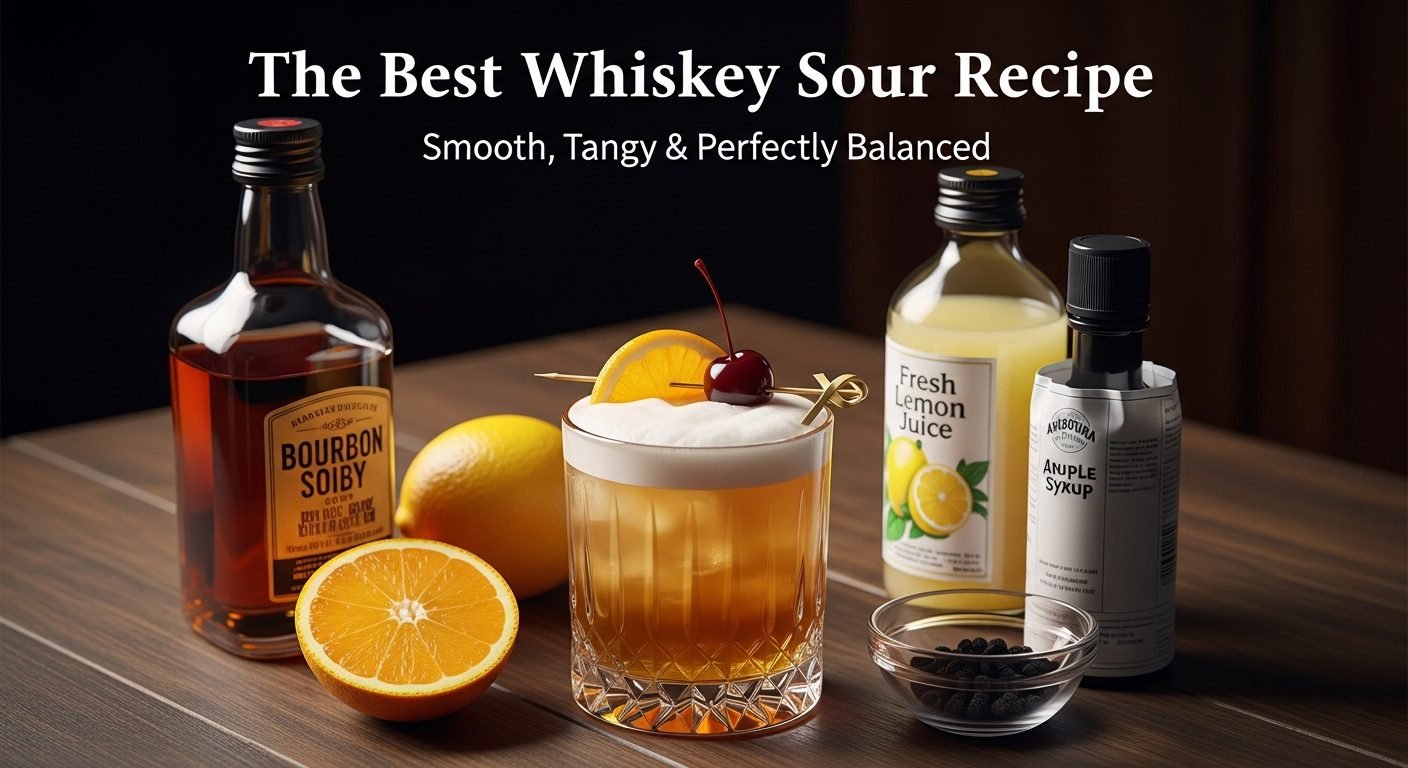
The Best Whiskey Sour Recipe – Smooth, Tangy & Perfectly Balanced

The Whiskey Sour is a timeless classic that perfectly balances the warmth of whiskey with bright citrus and just the right amount of sweetness. This refreshing cocktail is surprisingly simple to make at home, requiring just a handful of ingredients and about five minutes of your time. Unlike many cocktails that mask the spirit with sugary mixers, the Whiskey Sour celebrates the whiskey while the fresh lemon juice and simple syrup create a beautifully balanced drink that’s both sophisticated and approachable.
This cocktail is incredibly versatile for any occasion. Serve it as a refreshing happy hour drink on a warm summer evening, offer it at dinner parties as a pre-meal cocktail, or enjoy it as a special treat when you want something more elegant than a glass of wine. The Whiskey Sour works beautifully year-round, though its bright citrus notes make it especially popular during spring and summer. With its gorgeous golden color and optional frothy egg white topping, it’s as Instagram-worthy as it is delicious.
History / Background
The Whiskey Sour has a rich history that dates back to the 1860s, making it one of America’s oldest and most beloved cocktails. The drink first appeared in print in Jerry Thomas’s 1862 bartending guide “The Bartender’s Guide,” though many historians believe sailors were mixing similar combinations of spirits, citrus, and sugar long before that to prevent scurvy during long ocean voyages.
The true golden age of the Whiskey Sour came during the late 1800s and early 1900s, when it became a staple in American bars and saloons. The cocktail was particularly popular because it showcased American whiskey while the citrus and sugar made it accessible to drinkers who found straight whiskey too harsh. During this era, bartenders began adding egg white to create a silky texture and beautiful foam top, elevating the drink from a simple sour to something truly special.
The cocktail’s popularity continued through Prohibition, though quality suffered as bartenders had to work with inferior bootleg spirits. The addition of egg white and extra sugar during this period helped mask the harsh flavors of low-quality whiskey. After Prohibition ended, the Whiskey Sour regained its status as a respected cocktail, though it went through a decline in the 1970s and 1980s when many bars started using pre-made sour mix instead of fresh ingredients.
The craft cocktail renaissance of the 2000s brought the Whiskey Sour back to its roots. Modern bartenders returned to using fresh lemon juice, quality simple syrup, and proper technique, reminding everyone why this cocktail has survived for over 150 years. Today, the Whiskey Sour is recognized as one of the essential cocktails every bartender should know, and it continues to be a favorite among whiskey lovers and cocktail enthusiasts worldwide.
The beauty of the Whiskey Sour lies in its simplicity and the sour cocktail template it established. This basic formula of spirit, citrus, and sweetener has inspired countless variations including the Margarita, Daiquiri, and Pisco Sour, making the Whiskey Sour the grandfather of an entire family of cocktails.
Why You’ll Love This Recipe
This Whiskey Sour recipe delivers bar-quality results without any fancy equipment or hard-to-find ingredients. It uses fresh lemon juice instead of sour mix, which makes all the difference between a mediocre drink and an exceptional one. The recipe includes the optional egg white technique that professional bartenders use to create that gorgeous silky texture and beautiful foam cap, but it’s just as delicious without it if you prefer a simpler version.
Here’s why this recipe will become your go-to cocktail:
- Quick & Easy – Ready in just 5 minutes from start to finish with minimal effort
- Fresh Ingredients – Uses real lemon juice and homemade simple syrup for authentic flavor
- Perfectly Balanced – Not too sweet, not too sour, with the whiskey still shining through
- Customizable – Easy to adjust sweetness, tartness, and strength to your taste
- Impressive Presentation – The optional egg white creates a stunning foam top that wows guests
- Budget-Friendly – Makes multiple servings without breaking the bank
- Year-Round Appeal – Refreshing in summer, cozy in winter, perfect any season
- Beginner-Friendly – No complicated techniques or professional bar tools required
- Better Than Store-Bought – Infinitely superior to pre-made sour mix versions
- Classic with Flair – Timeless recipe that still feels special and sophisticated
Ingredient Notes
Understanding your ingredients is the key to making an outstanding Whiskey Sour. Each component plays an important role in creating the perfect balance.
Whiskey (Bourbon or Rye) – This is your base spirit and the star of the show. Bourbon creates a sweeter, smoother Whiskey Sour with notes of caramel and vanilla. Great bourbon options include Maker’s Mark, Buffalo Trace, or Woodford Reserve. Rye whiskey produces a spicier, drier cocktail with more bite. Try Bulleit Rye, Rittenhouse, or Wild Turkey Rye. Both work beautifully, so choose based on your preference. You don’t need expensive whiskey here—a quality mid-range bottle ($25-35) is perfect. Save your premium whiskeys for sipping neat.
Fresh Lemon Juice – This is absolutely non-negotiable. Fresh-squeezed lemon juice is what makes a great Whiskey Sour, and bottled lemon juice simply cannot compare. Fresh juice provides bright, vibrant acidity with complex flavor notes that bottled juice lacks. You’ll need about 2-3 medium lemons per cocktail. Always juice your lemons just before making the drink for maximum freshness. Room temperature lemons yield more juice than cold ones, so leave them on the counter for a bit before juicing.
Simple Syrup – This sweetener balances the tart lemon juice and smooths out the whiskey. Simple syrup is just equal parts sugar and water heated until dissolved. You can make it yourself in five minutes, or buy it at most grocery stores. Standard simple syrup is a 1:1 ratio, but some bartenders prefer rich simple syrup (2:1 sugar to water) which provides more sweetness per volume and doesn’t dilute the drink as much. Regular granulated white sugar works perfectly fine here.
Egg White (Optional but Recommended) – This is what takes your Whiskey Sour from good to spectacular. The egg white doesn’t add flavor but creates a silky, velvety texture and produces that beautiful foam cap on top of the drink. It also helps integrate all the flavors together. If you’re concerned about raw eggs, you can use pasteurized egg whites from a carton (1 oz equals one egg white), or simply omit it altogether—the drink will still be delicious. Some people substitute aquafaba (chickpea liquid) as a vegan alternative, though it doesn’t create quite the same texture.
Angostura Bitters (Optional) – A few drops on top of the foam add visual appeal and a subtle aromatic complexity that enhances the overall drinking experience.
Ice – You’ll need ice for shaking, and larger cubes are better as they chill the drink without over-diluting it.
Garnish – Traditional garnishes include a lemon wheel or wedge, and a maraschino cherry. The cherry is classic but optional. Some modern bartenders prefer just a lemon twist for a more refined presentation.
Equipment Needed
Making a Whiskey Sour doesn’t require a fully stocked professional bar, but having the right tools makes the process much easier:
- Cocktail Shaker – A Boston shaker or cobbler shaker for mixing and chilling the drink
- Jigger or Measuring Tool – For accurate measuring (1 oz, ¾ oz, and 2 oz measurements)
- Citrus Juicer – Handheld or electric juicer for extracting lemon juice
- Hawthorne Strainer – If using a Boston shaker (cobbler shakers have built-in strainers)
- Rocks Glass or Coupe Glass – For serving (rocks glass for over ice, coupe for up)
- Bar Spoon or Regular Spoon – For measuring and stirring simple syrup
- Fine-Mesh Strainer – Optional, for double-straining to remove pulp
- Small Saucepan – If making your own simple syrup
Print

Whiskey Sour Recipe
This classic Whiskey Sour recipe combines bourbon or rye whiskey with fresh lemon juice and simple syrup for a perfectly balanced cocktail that’s tangy, sweet, and smooth. The optional egg white creates a silky texture and beautiful foam top that makes this drink truly special.
- Total Time: 5 minutes
- Yield: 1 cocktail 1x
Ingredients
Scale- 2 oz bourbon or rye whiskey (60 ml)
- ¾ oz fresh lemon juice (22 ml, about ½ a large lemon)
- ¾ oz simple syrup (22 ml)
- 1 egg white or 1 oz pasteurized egg white (optional but recommended)
- Ice cubes for shaking
- 2-3 dashes Angostura bitters for garnish (optional)
- Lemon wheel and maraschino cherry for garnish
For Simple Syrup (makes about 1 cup):
- ½ cup water
- ½ cup granulated sugar
Instructions
Make Simple Syrup (if needed):
- Combine Sugar and Water – In a small saucepan, combine ½ cup water and ½ cup sugar. Place over medium heat.
- Heat Until Dissolved – Stir occasionally until the sugar completely dissolves into the water, about 3-4 minutes. You don’t need to boil it, just heat until clear.
- Cool Completely – Remove from heat and let cool to room temperature before using. Store leftover simple syrup in the refrigerator in an airtight container for up to one month.
Make the Whiskey Sour:
- Dry Shake (If Using Egg White) – Add whiskey, lemon juice, simple syrup, and egg white to your cocktail shaker WITHOUT ice. Seal the shaker tightly and shake vigorously for 15-20 seconds. This “dry shake” emulsifies the egg white and creates that beautiful foam. If not using egg white, skip to step 5.
- Add Ice and Shake Again – Open your shaker and add a generous amount of ice (fill about two-thirds full). Seal the shaker again and shake hard for another 15-20 seconds until the outside of the shaker feels ice-cold. This chills and dilutes the drink to perfection.
- Strain into Glass – Strain the cocktail into a rocks glass filled with fresh ice (for on the rocks) or into a chilled coupe glass (for serving up). If you want an extra-smooth texture without any ice chips or pulp, double-strain through a fine-mesh strainer as you pour.
- Add Garnish – If you used egg white and have a nice foam top, add 2-3 drops of Angostura bitters on the foam and use a toothpick to swirl them into a decorative pattern. Add a lemon wheel on the rim of the glass and a maraschino cherry if desired.
- Serve Immediately – Whiskey Sours are best enjoyed fresh while properly chilled. Sip and enjoy the perfect balance of flavors!
Notes
No Egg White Version: Simply combine whiskey, lemon juice, and simple syrup in a shaker with ice, shake for 15-20 seconds, strain, and serve. You’ll skip the dry shake step entirely. The drink will be just as delicious, just without the silky texture and foam top.
Adjusting Sweetness: The standard recipe uses ¾ oz simple syrup, but this is easily adjustable. If you prefer a tarter cocktail, reduce to ½ oz. For a sweeter version, increase to 1 oz. Taste and adjust to your preferences.
Bourbon vs Rye: Bourbon creates a sweeter, rounder Whiskey Sour, while rye produces a drier, spicier version. Many bartenders prefer rye because its spice notes complement the citrus beautifully, but bourbon is more approachable for those new to whiskey cocktails.
Shaking Technique: Shake hard and fast with a back-and-forth motion rather than up-and-down. The goal is to chill and dilute the cocktail while thoroughly mixing and aerating the ingredients. The outside of your shaker should feel painfully cold when it’s ready.
Why Two Shakes? When using egg white, the dry shake (without ice) emulsifies the egg protein and creates foam. The second shake with ice chills the drink without breaking down the foam structure. This two-step process is the secret to that gorgeous foam cap.
- Prep Time: 5 minutes
- Cook Time: 0 minutes
- Category: Cocktail, Drinks
- Method: Shaken
- Cuisine: American
- Diet: Gluten Free
Nutrition
- Serving Size: 1 cocktail (approximately 4 oz)
- Calories: 175
- Sugar: 12g
- Sodium: 15mg
- Fat: 0g
- Saturated Fat: 0g
- Unsaturated Fat: 0g
- Trans Fat: 0g
- Carbohydrates: 13g
- Fiber: 0g
- Protein: 2g (with egg white), 0g (without egg white)
- Cholesterol: 0mg
Tips & Variations
Make It Sweeter: Increase the simple syrup to 1 oz, or add a barspoon (¼ tsp) of maraschino cherry syrup for extra sweetness and a subtle cherry flavor. You can also use honey syrup (equal parts honey and water) instead of simple syrup for a richer sweetness.
Make It Tarter: Reduce simple syrup to ½ oz and/or add an extra ¼ oz of lemon juice. Some people love a super-tart Whiskey Sour that really makes you pucker.
New York Sour: After straining your Whiskey Sour into the glass, slowly pour ½ oz of red wine (typically a fruity red like Malbec or Shiraz) over the back of a spoon so it floats on top. This creates a beautiful layered effect and adds wine’s complexity to the cocktail.
Maple Whiskey Sour: Replace the simple syrup with pure maple syrup for a fall-inspired variation with rich, caramel notes. Reduce to ½ oz maple syrup as it’s sweeter than simple syrup.
Amaretto Sour Variation: Replace ½ oz of the whiskey with amaretto liqueur for a nutty, sweeter variation that’s incredibly popular.
Boston Sour: Add ½ oz of red wine, but mix it into the shaker rather than floating it on top. This creates a more integrated flavor profile.
Raspberry Whiskey Sour: Muddle 4-5 fresh raspberries in the shaker before adding the other ingredients. The berries add beautiful color and fruity flavor.
Herb-Infused Version: Add fresh herbs like thyme, rosemary, or basil to your simple syrup while it’s cooling for an aromatic twist. Strain out the herbs before using.
Spicy Whiskey Sour: Add 2-3 thin slices of jalapeño to the shaker before shaking for a spicy kick that pairs surprisingly well with the sweet-tart profile.
Lower Alcohol Version: Reduce whiskey to 1.5 oz and add ½ oz of club soda after straining for a lighter, more refreshing drink perfect for day drinking.
Pro Chef Tips
Fresh Juice Is Everything: This cannot be emphasized enough—fresh lemon juice is the single most important factor in making a great Whiskey Sour. Bottled juice tastes flat, artificial, and will ruin your cocktail. Always juice fresh lemons right before making the drink. If you must prep ahead, fresh juice can be refrigerated for up to 4 hours, but it loses brightness after that.
Master the Dry Shake: When using egg white, the dry shake (shaking without ice first) is crucial for creating that signature silky texture and foam. Shake hard for at least 15-20 seconds—your arm should get tired. Some bartenders even remove the spring from their Hawthorne strainer and add it to the shaker during the dry shake as a whisk to create even more foam. Then add ice and shake again. This technique makes all the difference.
Temperature and Dilution Balance: A perfect Whiskey Sour should be ice-cold but not watery. Fill your shaker two-thirds full with ice and shake for exactly 15-20 seconds. Less time and it won’t be cold enough; more time and it becomes over-diluted. The outside of your shaker should be frosty and almost painful to hold when ready.
Use Large Ice Cubes for Serving: If serving on the rocks, use one large ice cube or sphere rather than small cubes. Large ice melts much more slowly, keeping your drink cold without diluting it as quickly. This extends the window of perfect drinking.
Taste Your Components: Before mixing, taste your lemon juice and simple syrup separately. The lemon juice should be bright and tart without being bitter (which happens with over-juicing that includes pith). The simple syrup should be neutral and sweet. If either tastes off, your final cocktail will suffer.
The Reverse Dry Shake Method: Some bartenders prefer to shake with ice first, strain out the ice, then dry shake before pouring. This “reverse dry shake” creates even more stable foam that lasts longer in the glass. Try both methods and see which you prefer.
Chill Your Glassware: Always serve your Whiskey Sour in a chilled glass. Keep glasses in the freezer for at least 15 minutes, or fill them with ice water while you make the drink. A warm glass will immediately start warming your perfectly chilled cocktail.
Common Mistakes to Avoid
Using Bottled Lemon Juice or Sour Mix: This is the cardinal sin of Whiskey Sour making. Pre-made sour mix and bottled lemon juice taste artificial and flat, completely ruining what should be a bright, fresh cocktail. The difference between fresh-squeezed and bottled is night and day. Always, always use fresh lemons. There are no shortcuts here. If you don’t have fresh lemons, make a different cocktail.
Not Shaking Hard Enough or Long Enough: Whiskey Sours need vigorous shaking to properly chill, dilute, and integrate the ingredients. If you’re using egg white, inadequate shaking means your foam will be thin and disappointing. Really shake it—15-20 seconds minimum with enthusiastic back-and-forth motion. Your arm should feel the workout. A half-hearted shake produces a half-hearted cocktail.
Wrong Proportions: The classic 2:¾:¾ ratio (whiskey:lemon:simple syrup) creates perfect balance. Too much simple syrup makes it cloying; too little makes it harsh. Too much lemon makes it searingly tart; too little leaves it flat. When you’re learning, measure precisely with a jigger. Once you understand the balance, you can adjust to personal taste, but start with the standard proportions.
Adding Egg White Directly to Ice: If you add egg white to ice and shake, you’ll get minimal foam. The cold temperature prevents the egg proteins from properly whipping up. Always dry shake first (without ice) to create the foam, then add ice and shake again. This two-step process is essential for that beautiful foam top.
Over-Diluting When Serving on the Rocks: If you shake properly with ice, your cocktail is already perfectly diluted and chilled. Don’t then pour it over a glass full of small ice cubes that will melt quickly. Use one large ice cube or just a few cubes to keep it cold without further dilution. Better yet, serve it “up” in a chilled coupe glass without ice.
Storage & Meal Prep
Leftover Cocktail: Whiskey Sours are always best made fresh due to the fresh lemon juice and egg white. However, if you’ve made too much, you can store the mixture (without ice or garnish) in the refrigerator in an airtight container for up to 12 hours. The egg white foam will deflate completely, and you’ll lose some of the bright lemon flavor, but it’s still drinkable. Before serving, shake it again with fresh ice to re-chill and re-integrate the ingredients.
Fresh Lemon Juice Storage: Fresh-squeezed lemon juice can be stored in an airtight container in the refrigerator for up to 4 hours while maintaining good flavor. After that, it begins to oxidize and lose its brightness. If you need to prep juice further ahead, squeeze the lemons and freeze the juice in ice cube trays. Thaw before using, though fresh-never-frozen is always better.
Simple Syrup Storage: Homemade simple syrup keeps beautifully in the refrigerator for up to one month in an airtight container or bottle. Make a batch and you’ll have it ready whenever you want a cocktail. If you notice any cloudiness or mold, discard and make fresh.
Egg White Storage: If you separate eggs and have leftover egg whites, store them in an airtight container in the refrigerator for up to 4 days. Label with the date and number of whites. Alternatively, use pasteurized egg whites from a carton—they last much longer and are already measured (1 oz equals one egg white).
Make-Ahead & Freezer Notes
Pre-Batching Without Egg White: If you’re hosting a party and want to make multiple Whiskey Sours, you can batch the whiskey, lemon juice, and simple syrup ahead. Multiply the recipe by your number of guests and combine everything in a bottle or pitcher. Refrigerate for up to 4 hours. When ready to serve, add 3.5 oz of the mixture to a shaker with ice per cocktail, shake, and strain. This method won’t work well with egg whites, which need to be shaken fresh for each serving.
Freezer-Friendly Lemon Juice: You can freeze fresh lemon juice in ice cube trays, then transfer the cubes to a freezer bag for up to 3 months. Each standard ice cube tray well holds about 1 oz, making measuring easy. Thaw the cubes before use. While frozen juice doesn’t have quite the brightness of fresh, it’s far better than bottled juice and works in a pinch.
Simple Syrup in Advance: Simple syrup is the ultimate make-ahead component. Make a large batch (scale up the recipe), let it cool completely, and store in the refrigerator in a clean bottle or jar. It keeps for a month, so you’re always cocktail-ready.
Pre-Juiced Lemons: For convenience, you can juice lemons up to 4 hours ahead and refrigerate the juice in an airtight container. Bring to room temperature before using, or at least let it sit out for 10 minutes. Very cold juice doesn’t integrate as well during shaking.
Not Suitable for Long-Term Freezing: Unlike some cocktails, Whiskey Sours don’t freeze well due to the egg white (which separates) and fresh citrus (which loses flavor). Always make these fresh or within a few hours of serving.
Serving Suggestions
The Whiskey Sour is traditionally served as an apéritif cocktail—something you enjoy before dinner to stimulate the appetite. Its bright citrus notes and balanced sweetness make it perfect for whetting your appetite without filling you up.
Perfect Pairings:
Serve Whiskey Sours alongside savory appetizers that complement the cocktail’s sweet-tart profile. Think salty, rich, or spicy foods that contrast beautifully with the citrus. Excellent options include spiced nuts, bacon-wrapped dates, cheese and charcuterie boards featuring sharp aged cheeses, smoked salmon on crackers, buffalo wings, or deviled eggs.
For a more substantial pairing, Whiskey Sours work wonderfully with barbecue, grilled meats, or anything with a smoky flavor profile. The citrus cuts through rich, fatty foods while the whiskey complements smoke and char. Think pulled pork sliders, brisket, grilled steaks, or smoked chicken.
Surprisingly, Whiskey Sours also pair well with brunch foods. The cocktail’s citrus brightness complements eggs benedict, quiche, smoked salmon bagels, or french toast. It’s a sophisticated alternative to mimosas or bloody marys for daytime entertaining.
Occasion Ideas:
- Cocktail Hour: Serve Whiskey Sours during the cocktail hour before a dinner party with passed appetizers
- Summer Gatherings: The bright, refreshing citrus makes this perfect for warm weather entertaining on the patio
- Holiday Parties: A classic choice for Thanksgiving, Christmas, or New Year’s Eve celebrations
- Game Day: Elevate your sports watching with craft cocktails instead of beer
- Date Night: Impress your partner with perfectly crafted cocktails at home
- Brunch Entertaining: Offer as an elegant option alongside traditional brunch cocktails
Serving Style Options:
The Whiskey Sour can be served two ways, each with its own appeal. “Up” means served in a chilled coupe or martini glass without ice—this is the more elegant presentation and keeps the drink pristinely cold without dilution. “On the rocks” means served over ice in a rocks glass—this keeps the drink colder longer and provides gradual dilution that some people prefer, especially with higher-proof whiskeys.
FAQs Section
Do I have to use egg white in a Whiskey Sour?
Absolutely not! The egg white is traditional and creates a beautiful silky texture with that signature foam top, but the cocktail is still delicious without it. If you’re concerned about raw eggs, prefer a simpler drink, or are vegan, just skip the egg white entirely. Your Whiskey Sour will still have the perfect balance of whiskey, lemon, and sweetness—just without the velvety texture. You can also use pasteurized egg whites from a carton if food safety is your concern, or try aquafaba (the liquid from canned chickpeas) as a vegan alternative, though it creates a slightly different texture.
Can I use bottled lemon juice instead of fresh?
While you technically can, you really shouldn’t. Fresh-squeezed lemon juice is the single most important ingredient in a great Whiskey Sour, and bottled juice simply cannot compare. Bottled lemon juice tastes flat, artificial, and lacks the bright, complex acidity of fresh juice. The difference is dramatic and immediately noticeable. Fresh lemons are inexpensive and widely available, and squeezing them takes just two minutes. This is the one ingredient where there’s no acceptable shortcut. Trust me—use fresh lemons, and your Whiskey Sours will be infinitely better.
What’s the difference between using bourbon and rye whiskey?
Bourbon and rye create distinctly different Whiskey Sours. Bourbon is made with at least 51% corn, giving it a sweeter, smoother profile with notes of vanilla, caramel, and butterscotch. A bourbon Whiskey Sour is rounder, mellower, and more approachable—great for people who are newer to whiskey cocktails. Rye whiskey must contain at least 51% rye grain, which produces a spicier, drier spirit with notes of pepper, baking spice, and herbs. A rye Whiskey Sour is brighter, more complex, and has more bite—many bartenders prefer it because the spice complements the citrus beautifully. Both are traditional and correct; choose based on your taste preference.
How do I get that perfect foam on top?
The secret to gorgeous foam is the two-step shaking process called a “dry shake.” First, add whiskey, lemon juice, simple syrup, and egg white to your shaker WITHOUT ice. Seal tightly and shake hard for 15-20 seconds—this emulsifies the egg white and creates foam. Then add ice and shake again for another 15-20 seconds to chill the drink. The key is really vigorous shaking during that first dry shake. Your arm should get tired. Some bartenders remove the spring from their Hawthorne strainer and add it to the shaker during the dry shake to help whip the egg white even more. Finally, strain carefully to preserve the foam structure.
Can I make Whiskey Sours ahead for a party?
You can partially prepare them, but they’re best made to order or very close to serving time. The fresh lemon juice begins to lose its brightness after a few hours, and the egg white foam deflates quickly. For parties, your best approach is to pre-measure and batch the whiskey, lemon juice, and simple syrup in a bottle or pitcher (multiply the recipe by your guest count). Refrigerate for up to 4 hours. When ready to serve, shake individual portions with egg white and ice as described. This way you’re not squeezing lemons and measuring for each drink, but you’re still making them fresh. Alternatively, skip the egg white for parties and just shake the pre-batched mixture with ice and strain—much faster for a crowd.
Why is my Whiskey Sour too watery or too strong?
Getting the dilution right is crucial. If your drink is too watery, you’re either shaking too long (over 20 seconds with ice), using ice that’s too small or broken up (which melts quickly), or adding too much ice to the serving glass. Use larger ice cubes, shake for exactly 15-20 seconds, and serve with minimal ice or “up” without ice. If your drink is too strong and harsh, you’re not shaking long enough with ice—you need that 15-20 seconds to properly chill and dilute the cocktail. The proper dilution from shaking with ice is essential to balance the strong whiskey and tart lemon.
How can I tell if my simple syrup or lemon juice has gone bad?
Simple syrup lasts about a month refrigerated. It’s gone bad if you see any cloudiness, mold growth, or notice a fermented smell. When in doubt, make fresh—it only takes five minutes. Fresh lemon juice is more time-sensitive; it’s best within 4 hours of juicing. After that, it begins to oxidize and lose brightness. You’ll notice it tastes less vibrant and bright, more flat and dull. If your lemon juice has been refrigerated for more than a day, it’s past its prime for cocktails, though it’s still safe to drink. The quality just won’t be the same. Always aim to juice lemons as close to cocktail-making time as possible.
Conclusion
The Whiskey Sour is one of those rare cocktails that manages to be both simple and sophisticated. With just a handful of fresh ingredients and proper technique, you can create a bar-quality drink in your own kitchen that rivals anything you’d order at a high-end cocktail bar. The beauty of this recipe lies in its perfect balance—not too sweet, not too tart, with the whiskey still shining through as the star.
Whether you’re making your first Whiskey Sour or your hundredth, this recipe delivers consistent, delicious results every single time. The optional egg white takes it to the next level with that signature silky texture and beautiful foam, but even without it, you’ll have a refreshingly balanced cocktail that’s perfect for any occasion. Once you master this classic, you’ll find yourself reaching for it again and again, whether you’re unwinding after a long day, entertaining friends, or simply treating yourself to something special.
So grab some fresh lemons, your favorite whiskey, and get shaking! Your perfect Whiskey Sour is just five minutes away. Once you taste the difference that fresh ingredients and proper technique make, you’ll never go back to store-bought sour mix again. Here’s to you, and to perfectly balanced cocktails made with care. Cheers!