Classic Negroni Recipe – The Perfect Bitter Italian Cocktail

If you’re ready to venture into the world of sophisticated, grown-up cocktails, the Negroni is your gateway drink. This iconic Italian cocktail is deceptively simple – just three ingredients in equal parts – yet delivers a complex, bittersweet flavor that’s unlike anything else in the cocktail world. With its stunning ruby-red color, botanical complexity, and perfect balance of bitter and sweet, the Negroni has captivated cocktail enthusiasts for over a century and continues to be one of the most popular drinks at upscale bars worldwide.
What makes the Negroni so special is its bold, unapologetic character. This isn’t a sweet, easy-drinking cocktail that tries to please everyone – it’s assertive, bitter, and deeply flavorful. The combination of gin’s botanicals, Campari’s bitter intensity, and sweet vermouth’s herbal richness creates something that’s both refreshing and contemplative. It’s the perfect pre-dinner drink (aperitivo in Italian) designed to stimulate your appetite and conversation.
I absolutely love making Negronis because they’re the ultimate expression of “less is more” in cocktail craft. You need exactly three ingredients, no complicated techniques, and about two minutes of your time. Yet the result tastes like something from a Michelin-starred restaurant bar. Whether you’re hosting a dinner party, enjoying a quiet evening at home, or wanting to impress your cocktail-loving friends, the Negroni brings instant sophistication to any occasion. Plus, that gorgeous deep red color looks absolutely stunning in photos – pure Pinterest gold!
History & Background of the Negroni
The Negroni has one of the most charming origin stories in cocktail history, and like many legendary drinks, it begins with a customer request. The year was 1919, and the place was Caffè Casoni in Florence, Italy (now called Caffè Cavalli). Count Camillo Negroni, a Florentine aristocrat who had spent time in the American West, walked into the bar and asked bartender Fosco Scarselli to strengthen his favorite cocktail, the Americano.
The Americano – a popular drink at the time – consisted of Campari, sweet vermouth, and soda water. Count Negroni wanted something with more kick, so Scarselli replaced the soda water with gin and added an orange garnish instead of the Americano’s traditional lemon. This simple substitution created something entirely new and extraordinary. The drink was named after the Count, and the Negroni was born.
The Negroni remained relatively local to Florence for several decades, enjoyed primarily by Italian locals who appreciated its bitter complexity. However, Italian aperitivo culture gradually spread throughout Europe in the mid-20th century, and the Negroni came along for the ride. By the 1960s and 1970s, the drink had gained international recognition, appearing in cocktail books and upscale bars across Europe and America.
What’s fascinating about the Negroni is how it perfectly represents Italian drinking culture. In Italy, the aperitivo hour is sacred – that pre-dinner ritual of enjoying a bitter cocktail with small snacks to stimulate appetite and facilitate conversation. Bitter flavors are believed to aid digestion and prepare the palate for the meal to come. The Negroni embodies this philosophy perfectly, offering bold bitterness balanced by just enough sweetness to keep it civilized.
The drink experienced a massive revival during the craft cocktail renaissance of the 2000s and 2010s. Bartenders rediscovered classic cocktails, and the Negroni’s simple elegance and complex flavor made it a natural favorite. Its equal-parts ratio (1:1:1) made it easy to remember and hard to mess up, while still offering endless opportunities for creativity and experimentation with different gins, vermouths, and even Campari alternatives.
Today, the Negroni has achieved iconic status alongside cocktails like the Martini, Manhattan, and Old Fashioned. There’s even an official “Negroni Week” celebrated annually in June, where bars worldwide donate proceeds from Negroni sales to charity. The drink has inspired countless variations (White Negroni, Boulevardier, Negroni Sbagliato) and become a badge of honor among cocktail enthusiasts – ordering a Negroni signals you’re a serious drinker with sophisticated taste.
Interestingly, the Negroni has become somewhat of a litmus test for cocktail appreciation. Its bold bitterness can be off-putting to those accustomed to sweet cocktails, but for many people, the Negroni represents the moment their palate matured and they “got it.” That first perfect Negroni often marks a turning point in someone’s cocktail journey, opening the door to a whole world of bitter, complex drinks.
Why You’ll Love This Negroni Recipe
This Negroni recipe is about to become your signature cocktail, and I’m absolutely confident about this. I’ve made hundreds of Negronis over the years – for myself, for guests, for dinner parties – and I can tell you that this perfectly balanced version hits all the right notes. There’s something incredibly satisfying about that first sip: the initial bitter shock, followed by botanical complexity, then sweet herbal notes, all working together in perfect harmony.
Here’s why this recipe deserves a permanent spot in your cocktail repertoire:
- Remarkably Simple – Just 3 ingredients in equal parts, impossible to forget
- No Special Skills – If you can measure and stir, you can make a perfect Negroni
- Deeply Complex Flavor – Despite simplicity, delivers sophisticated taste
- Pre-Dinner Perfect – The ultimate aperitivo to stimulate appetite
- Conversation Starter – Bold, distinctive taste always sparks discussion
- Endlessly Customizable – Swap gins and vermouths for different profiles
- Budget-Friendly – One bottle each makes 8-10 cocktails
- Looks Stunning – That deep ruby color is absolutely gorgeous
- Adult & Sophisticated – For serious cocktail enthusiasts
- Quick to Make – Ready in 2 minutes from start to finish
- Scales Easily – Make one drink or batch for a party
- Timeless Classic – A 100+ year old cocktail that never goes out of style
Ingredient Notes
Gin: The botanical spirit that provides the Negroni’s aromatic foundation and structure. London Dry gin is traditional and most commonly used – brands like Beefeater, Tanqueray, or Bombay Sapphire in the $20-30 range work beautifully. The juniper and botanical flavors need to be assertive enough to stand up to Campari’s intensity. Substitution: For a different botanical profile, try contemporary gins like Hendrick’s (cucumber notes) or The Botanist (floral). For a completely different drink, substitute bourbon or rye whiskey to make a Boulevardier, or mezcal for a smoky variation. Each spirit creates a distinctly different cocktail.
Campari: The iconic Italian bitter liqueur that gives the Negroni its signature red color and bold bitterness. Campari’s secret recipe includes bitter orange, herbs, and spices, creating a complex flavor that’s intensely bitter yet oddly compelling. At 24% ABV, it’s lower alcohol than most spirits but incredibly flavorful. One bottle costs around $25-30 and makes many cocktails. Substitution: Aperol creates a lighter, sweeter version (often called a “Negroni Sbagliato” if you also use prosecco instead of gin). Gran Classico is a more vanilla-forward alternative. There’s no perfect substitute for Campari’s unique bitterness – it’s truly distinctive.
Sweet Vermouth (Rosso): This fortified, aromatized wine adds sweetness, herbal complexity, and body to balance Campari’s bitterness. Quality matters significantly here – use Italian sweet vermouth like Carpano Antica Formula (the gold standard), Cocchi di Torino, Punt e Mes, or Dolin Rouge. Cheap vermouth tastes flat and medicinal. Vermouth is perishable once opened – it’s wine-based and will oxidize. Store opened bottles in the refrigerator and use within 1-2 months. Important: Never use dry vermouth in a Negroni; it must be sweet (rosso/rouge) vermouth.
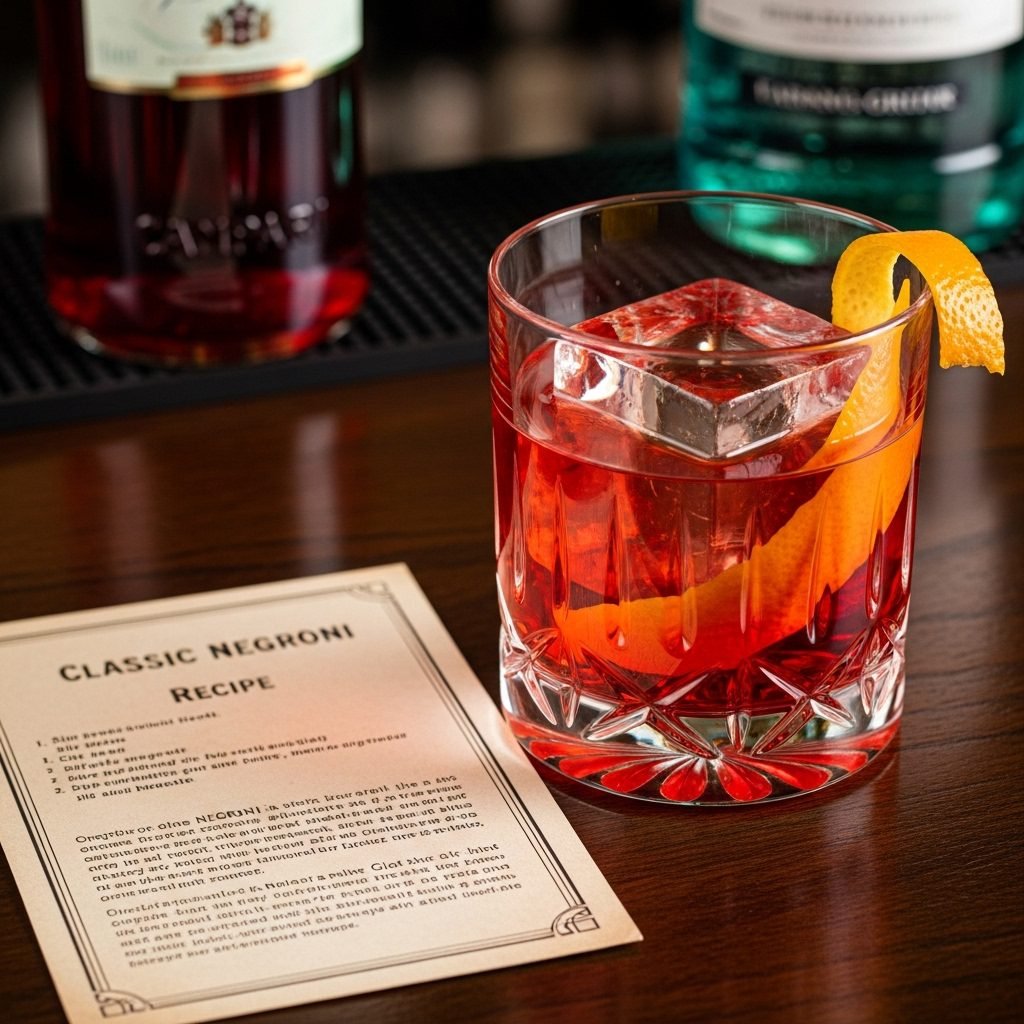
Orange Peel (Garnish): Fresh orange peel is essential, not optional decoration. Expressing the oils over the drink adds aromatic complexity and bright citrus notes that balance the bitter elements. Always use fresh orange, never dried or dehydrated garnish. The oils make a significant difference to the drinking experience.
Ice: Large ice cubes or one large sphere are ideal for Negronis. They melt slowly, keeping your drink cold without excessive dilution. The Negroni is meant to be sipped slowly, so ice quality matters. Avoid small ice cubes that melt quickly and water down the drink.
Equipment Needed
The Negroni requires minimal equipment, making it accessible to home bartenders:
- Mixing Glass – For stirring the cocktail with ice. A pint glass works if you don’t have a proper mixing glass
- Bar Spoon – Long-handled spoon for stirring. A regular spoon works in a pinch
- Jigger or Measuring Tool – For accurate 1 oz measurements
- Rocks Glass (Old Fashioned Glass) – The traditional serving vessel for Negroni
- Hawthorne Strainer – To strain the stirred cocktail into your glass. Not essential if you’re careful pouring
- Knife or Vegetable Peeler – For creating orange peel garnish
- Cutting Board – For working with oranges
- Ice Cubes – Large cubes or one large sphere per drink
Print

Negroni Recipe
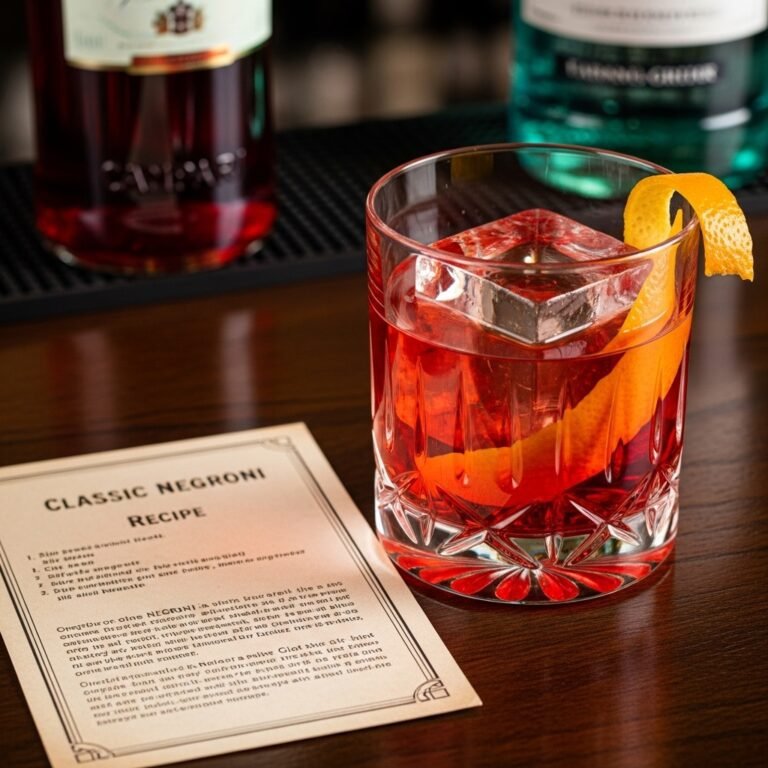
The classic Negroni is an iconic Italian cocktail featuring equal parts gin, Campari, and sweet vermouth. This sophisticated, bittersweet drink with a stunning ruby color is the perfect aperitivo for stimulating appetite before dinner. Bold, complex, and absolutely timeless!
- Total Time: 3 minutes
- Yield: 1 cocktail 1x
Ingredients
Scale- 1 oz (2 tablespoons) gin
- 1 oz (2 tablespoons) Campari
- 1 oz (2 tablespoons) sweet vermouth (rosso)
- Large ice cube or several smaller cubes
- Orange peel for garnish
- Optional: Ice for stirring (if different from serving ice)
Instructions
- Prepare Your Orange Peel: Before mixing your drink, prepare your garnish. Using a vegetable peeler or sharp knife, remove a wide strip of orange peel about 2-3 inches long and about ¾-inch wide. Try to get just the orange outer peel, avoiding as much of the white pith as possible (it’s bitter in an unpleasant way). Set aside on your cutting board.
- Chill Your Glass (Optional): For an extra-cold Negroni, place your rocks glass in the freezer for 10-15 minutes before making your drink. This step is optional but recommended for optimal temperature. If you don’t have time, simply add ice to your serving glass and proceed.
- Add Ice to Mixing Glass: Fill your mixing glass about halfway to two-thirds full with ice cubes. You need enough ice to properly chill the drink as you stir, but not so much that you can’t stir comfortably.
- Measure and Combine Ingredients: Using your jigger, measure exactly 1 ounce of gin and pour it into the mixing glass over ice. Then measure 1 ounce of Campari and add it. Finally, measure 1 ounce of sweet vermouth and add it. The equal parts ratio (1:1:1) is the classic and most balanced recipe.
- Stir, Don’t Shake: Using your bar spoon, stir the mixture gently but continuously for about 20-30 seconds. You’re aiming for proper dilution and temperature, not just mixing. The outside of the mixing glass should become frosty. Stirring, not shaking, keeps the drink silky and clear rather than cloudy. Count about 30-40 rotations.
- Prepare Serving Glass: If you haven’t pre-chilled your rocks glass, add one large ice cube or 2-3 regular ice cubes to it now. Large format ice is preferable – it melts slowly and keeps your Negroni cold without excessive dilution.
- Strain into Glass: Using your strainer, pour the stirred Negroni from your mixing glass over the fresh ice in your rocks glass. If you don’t have a strainer, carefully pour while holding back the ice with your bar spoon. The cocktail should be a beautiful, clear ruby red color.
- Express the Orange Peel: This is the crucial final step! Hold the orange peel over your drink with the orange side (not white pith side) facing down toward the glass. Hold it about 2-3 inches above the drink. With both hands, give the peel a firm twist – you should see and smell a fine mist of citrus oils spray onto the surface of your Negroni. This adds incredible aromatic complexity.
- Garnish and Serve: After expressing the oils, run the orange peel around the rim of the glass to coat it with oils, then either drop the peel into the drink or rest it on the edge of the glass as decoration. Some people prefer to twist the peel into a spiral for visual appeal.
- Enjoy Slowly: The Negroni is meant to be sipped slowly and contemplatively, preferably before dinner. Take your time and savor the complex layers of flavor. Salute!
Notes
- The 1:1:1 Ratio: The equal parts ratio is traditional and perfectly balanced, but can be adjusted to taste once you’re familiar with the drink.
- Stirring Time: Don’t under-stir (harsh, not cold enough) or over-stir (too diluted). 20-30 seconds is the sweet spot.
- Vermouth Quality: This is crucial. Use good Italian sweet vermouth and keep it refrigerated after opening.
- Fresh is Best: Vermouth oxidizes quickly once opened. If your vermouth is more than 2 months old, buy fresh for best results.
- Temperature Matters: Everything should be properly chilled. Warm Negronis taste overly harsh and medicinal.
- Batch Option: You can pre-mix the spirits (gin, Campari, vermouth) in a bottle. When ready to serve, pour 3 oz over ice, stir briefly, and garnish.
- Prep Time: 3 minutes
- Cook Time: 0 minutes
- Category: Cocktail/Beverage
- Method: Stirring
- Cuisine: Italian
- Diet: Gluten Free
Nutrition
- Serving Size: 1 Negroni
- Calories: 195
- Sugar: 7g
- Sodium: 2mg
- Fat: 0g
- Saturated Fat: 0g
- Unsaturated Fat: 0g
- Trans Fat: 0g
- Carbohydrates: 8g
- Fiber: 0g
- Protein: 0g
- Cholesterol: 0mg
Tips & Variations
Spirit Variations:
- Boulevardier: Replace gin with bourbon or rye whiskey for a richer, more American version
- Old Pal: Use rye whiskey and substitute dry vermouth for sweet vermouth
- Unusual Negroni: Use mezcal instead of gin for smoky complexity
- Cynar Negroni: Replace Campari with Cynar (artichoke liqueur) for earthier bitterness
Vermouth Variations:
- Punt e Mes: Use this bitter vermouth for even more complexity
- Carpano Antica: The gold standard – vanilla and spice notes
- Cocchi di Torino: Slightly lighter with caramel notes
- Half & Half: Try 0.5 oz sweet and 0.5 oz dry vermouth for different balance
Bitter Liqueur Alternatives:
- White Negroni: Use Suze or Luxardo Bitter Bianco instead of Campari, and Lillet Blanc instead of sweet vermouth
- Aperol Negroni: Substitute Aperol for lighter, less bitter version
- Gran Classico: Vanilla-forward alternative to Campari
Ratio Adjustments:
- 2:1:1 Ratio: Double the gin (2 oz gin, 1 oz each Campari and vermouth) for more gin-forward
- 1:1:2 Ratio: Double the vermouth for sweeter, softer Negroni
- Negroni Sbagliato: Replace gin with prosecco for lighter, bubbly version
Flavor Enhancements:
- Barrel-Aged Negroni: Age pre-mixed Negroni in small oak barrel for 2-4 weeks
- Negroni Sour: Add ½ oz fresh lemon juice for citrus brightness
- Spiced Negroni: Add dash of aromatic bitters or orange bitters
- Strawberry Negroni: Muddle fresh strawberry before building drink
Garnish Alternatives:
- Grapefruit peel instead of orange for different citrus profile
- Lemon peel for brighter, more tart aromatics
- Both orange and lemon peels for complexity
- Rosemary sprig for herbal, piney notes
Pro Chef Tips
Tip #1: The Stir Makes or Breaks the Drink
Stirring technique is absolutely critical for a perfect Negroni. You want to stir for 20-30 seconds – long enough to properly chill and dilute the drink, but not so long that you over-dilute it. The drink needs about 25% dilution from melting ice to reach optimal balance and temperature. Under-stirring leaves the Negroni harsh, aggressive, and warm. Over-stirring makes it watery and weak. The outside of your mixing glass should frost over during stirring – that’s your visual cue. Use a smooth, continuous circular motion rather than aggressive churning. Professional bartenders count rotations: aim for 30-40 complete circles.Tip #2: Vermouth Quality is Non-Negotiable
Many home bartenders underestimate vermouth’s importance in a Negroni, thinking it’s just a minor ingredient. Wrong! The vermouth is literally one-third of your drink and significantly impacts the final flavor. Cheap vermouth tastes flat and medicinal, ruining an otherwise perfect Negroni. Invest in quality Italian sweet vermouth – Carpano Antica Formula is the gold standard and transforms the drink. Additionally, vermouth is perishable! It’s fortified wine that oxidizes after opening. Store opened bottles in the refrigerator and use within 1-2 months. Stale vermouth is the number one reason home Negronis taste inferior to bar versions.Tip #3: Large Ice Makes a Huge Difference
The ice in your serving glass matters more than you might think. Large format ice cubes (or one large sphere) melt significantly slower than small cubes, keeping your Negroni cold without watering it down as you sip. Since Negronis are meant to be sipped slowly over 15-20 minutes, ice quality directly impacts the drinking experience. Small ice cubes melt rapidly, diluting your carefully crafted cocktail into weak, watery disappointment. Invest in large cube ice molds (silicone ones are cheap on Amazon) or buy large ice from specialty stores. This single upgrade dramatically improves your Negroni game.Tip #4: The Orange Expression is Essential, Not Optional
Expressing the orange peel over your Negroni isn’t just bartender showmanship – it fundamentally changes the drink. When you twist that peel firmly over the glass, you’re releasing aromatic essential oils that float on the surface and hit your nose with every sip. This aromatic layer adds brightness and citrus complexity that balances Campari’s bitterness. Without it, you’re missing a crucial component. The difference between a Negroni with and without properly expressed orange is night and day. Always use fresh orange (never dried), and twist firmly enough to see the oil mist – that’s how you know you’re doing it right.Tip #5: Temperature Control is Critical
A warm Negroni tastes unbalanced, overly harsh, and medicinal. Cold temperatures mellow the bitterness and bring out the cocktail’s complexity. Everything should be properly chilled: your spirits can be kept in the freezer (they won’t freeze solid due to alcohol content), your mixing glass should be cold, you need plenty of ice for stirring, and your serving glass should ideally be pre-chilled. Some bartenders even keep their vermouth in the freezer. This attention to temperature is what separates professional-quality Negronis from disappointing home versions. If your Negroni tastes too harsh or medicinal, it’s almost always a temperature issue.Common Mistakes to Avoid
Mistake #1: Using Old or Poorly Stored Vermouth
This is the single most common mistake and the primary reason home Negronis don’t taste as good as bar versions. Vermouth is wine-based and perishable – once opened, it begins oxidizing immediately. After 1-2 months in the refrigerator (or worse, in the cabinet), vermouth turns flat, dull, and slightly vinegary. Many people have bottles of vermouth that have been open for 6+ months or even years, sitting at room temperature. This stale vermouth makes terrible Negronis. Always refrigerate vermouth after opening, and replace it every 1-2 months if you drink Negronis regularly. This single fix will dramatically improve your cocktails.Mistake #2: Shaking Instead of Stirring
Negronis should always be stirred, never shaken. Shaking creates an aerated, cloudy cocktail with tiny air bubbles and ice chips that dilute rapidly. Stirring creates a crystal-clear, silky-smooth drink with proper texture and appearance. Shaking also introduces excessive dilution through violent ice agitation and creates a less elegant drinking experience. The only time to shake a Negroni is if you’re intentionally making a variation that includes citrus juice (like a Negroni Sour). For the classic version, always stir gently and patiently.Mistake #3: Neglecting the Equal Parts Ratio
While ratios can be adjusted once you’re experienced, beginners often get creative too early and throw off the careful balance. The 1:1:1 ratio exists for good reason – it creates perfect harmony between gin’s botanicals, Campari’s bitterness, and vermouth’s sweetness. Skewing the ratio without understanding why creates unbalanced drinks: too much Campari is overpoweringly bitter, too much gin becomes harsh and juniper-forward, too much vermouth turns cloying and sweet. Master the classic equal parts version first, then experiment knowingly with adjustments based on your preferences.Mistake #4: Skipping or Poorly Executing the Orange Peel
Some people drop an orange slice in the drink or skip garnish entirely. Big mistake! The orange peel (zest only, not the whole slice) must be expressed over the drink to release essential oils. An orange slice adds unwanted sweetness and watery juice that dilutes and unbalances the cocktail. The peel provides aromatic oils without affecting the drink’s balance. Additionally, many people use dried or dehydrated orange peel – these have lost their essential oils and add nothing. Always use fresh orange, and always express it properly by twisting firmly over the drink’s surface.Mistake #5: Not Stirring Long Enough
Impatience ruins many Negronis. A quick 5-10 second stir isn’t enough – the drink won’t be properly chilled or diluted, tasting harsh, hot, and unbalanced. You need a full 20-30 seconds of continuous stirring to achieve proper temperature (very cold) and dilution (about 25% water from melted ice). This seems like a long time when you’re standing there stirring, but it’s essential. The drink should taste smooth, cold, and complex – not aggressive and boozy. Set a timer if needed until you develop muscle memory for the right duration.Storage & Meal Prep
Storing Individual Ingredients:
Gin: Store at room temperature indefinitely, or keep in the freezer for extra-cold cocktails (it won’t freeze solid). Gin doesn’t spoil or degrade over time.Campari: Store at room temperature away from direct sunlight. Campari has a long shelf life due to its alcohol content and can last for years. The flavor may mellow slightly over time but remains perfectly usable.
Sweet Vermouth: This is the tricky one! Once opened, sweet vermouth must be refrigerated and should be used within 1-2 months for optimal flavor. After this, it oxidizes and loses its vibrant herbal character. If you rarely make Negronis, consider buying smaller 375ml bottles or using vacuum preservation systems (like Private Preserve) to extend shelf life.
Pre-Batching Negronis:
You can absolutely pre-mix the three spirits for convenience. Combine equal parts gin, Campari, and sweet vermouth in a bottle or jar. When ready to serve, pour 3 ounces over ice in a rocks glass, stir briefly for 5-10 seconds to chill, and garnish. Pre-batched Negronis can be stored in the refrigerator for up to 2 weeks. Some people pre-batch with additional water to account for dilution from stirring (add about 1 oz water per 3 oz of spirits), creating “instant” Negronis that just need ice and garnish.Bar Bottle Method:
Pour your pre-batched Negroni mixture into an empty liquor bottle and keep it in the freezer. Since the alcohol content is high, it becomes extremely cold and slightly syrupy but won’t freeze solid. When ready to serve, pour 3 ounces directly over ice in a rocks glass – no stirring needed since it’s already ice-cold. Garnish and enjoy. This method is popular among Negroni enthusiasts.Orange Peel Storage:
You can cut orange peels up to 2 hours ahead and store them submerged in water in the refrigerator to keep them fresh and pliable. Pat dry before using. Don’t prepare them too far ahead or they’ll dry out and lose essential oils.Make-Ahead & Freezer Notes
Batch Negronis for Parties:
For large gatherings, pre-batching is ideal. Mix the following ratios in a bottle or pitcher:- 1 bottle (750ml) gin
- 1 bottle (750ml) Campari
- 1 bottle (750ml) sweet vermouth
- 8-12 oz water (accounts for dilution from stirring)
This makes approximately 20-25 servings. Store in the refrigerator or freezer. When serving, pour 3-4 oz over ice in rocks glasses and garnish with orange peel. No stirring needed if you’ve added water. Label bottles clearly!
Frozen Negroni Method:
Some cocktail enthusiasts freeze pre-batched Negronis (with added water for dilution) in the bottle. The high alcohol content means it becomes extremely cold and viscous but doesn’t freeze solid. Pour directly from freezer into rocks glasses over ice for instantly perfect temperature. This method is controversial among purists but convenient for parties.Individual Portion Prep:
Measure individual Negroni portions (1 oz each of gin, Campari, vermouth) into small bottles or mason jars. Store in refrigerator for up to 2 weeks. When ready to serve, pour one portion over ice, stir briefly, and garnish. This speeds up service at parties significantly.Make-Ahead Timeline for Entertaining:
- 1 week ahead: Verify vermouth freshness; buy new if needed
- 2-3 days ahead: Pre-batch Negroni mixture if desired
- Day of party: Prep orange peels, chill rocks glasses
- Just before guests arrive: Set up bar station with ice, glasses, garnishes, and pre-batched mixture
Quick Assembly for Groups:
With pre-batched mixture ready:- Line up rocks glasses (30 seconds)
- Add ice to all glasses (1 minute)
- Pour 3 oz mixture into each glass (2 minutes)
- Brief stir each glass (2 minutes)
- Express and garnish with orange peel (3 minutes) Total: About 8-9 minutes for 6 Negronis
Serving Suggestions
Perfect Food Pairings:
Italian Aperitivo Snacks:
Honor the Negroni’s Italian heritage by serving it during aperitivo hour with traditional Italian snacks: mixed olives, salted almonds, marinated artichokes, prosciutto-wrapped breadsticks, chunks of Parmigiano-Reggiano, salami and coppa, focaccia pieces, or crostini with various toppings. The Negroni’s bitterness stimulates appetite perfectly before a meal.Cheese & Charcuterie:
The Negroni pairs beautifully with rich, fatty foods that balance its bitterness. Create a cheese board featuring aged cheeses like aged Gouda, sharp cheddar, Manchego, or blue cheese alongside cured meats, dried fruits, nuts, and crackers. The cocktail’s bitter complexity cuts through rich, creamy cheeses perfectly.Small Bites & Appetizers:
Serve alongside stuffed mushrooms, bacon-wrapped dates, deviled eggs, bruschetta, arancini (fried risotto balls), or antipasto skewers. Salty, savory flavors complement the Negroni’s profile beautifully.Nuts & Salty Snacks:
Simple salted or spiced nuts (Marcona almonds, roasted cashews, spicy pecans) are classic Negroni companions. The salt balances bitterness while the fat provides richness.Rich Dinner Foods:
While Negronis are traditionally pre-dinner drinks, they pair well with rich main courses: osso buco, braised short ribs, duck breast, lamb chops, or hearty pasta dishes with cream or meat sauces. The bitterness cuts through richness beautifully.Chocolate Desserts:
Surprisingly, Negronis work with dark chocolate desserts. The bitter notes in both complement each other. Try with dark chocolate mousse, flourless chocolate cake, or chocolate-covered orange peels.Occasion-Specific Serving:
- Dinner Parties: Serve during cocktail hour before seated dinner
- Italian-Themed Nights: Pair with Italian meal from appetizers through dessert
- Sophisticated Gatherings: Perfect for upscale, adult-only events
- Winter Evenings: The bitter warmth is comforting in cold weather
- Celebrations: Marks special occasions with serious style
- Tasting Parties: Host a Negroni tasting with different gins and vermouths
FAQs About Negronis
What does a Negroni taste like?
A Negroni has a complex, bittersweet flavor profile that’s quite distinctive. The first taste hits you with pronounced bitterness from Campari, followed by botanical juniper and herbal notes from gin, balanced by the sweet, wine-like richness of vermouth. There are layers of orange, herbs, spices, and a slight medicinal quality that some describe as “grown-up” or sophisticated. The overall impression is bold, bitter, slightly sweet, and deeply complex. If you enjoy bitter flavors like dark chocolate, coffee, or bitter greens, you’ll likely appreciate the Negroni. It’s definitely an acquired taste for those accustomed to sweet cocktails.Is a Negroni a strong drink?
Yes, the Negroni is a relatively strong cocktail. All three ingredients contain alcohol: gin (40% ABV), Campari (24% ABV), and sweet vermouth (15-18% ABV). A standard Negroni contains approximately 1.5-2 standard drinks. The final cocktail is roughly 24-28% alcohol by volume after dilution from stirring and ice. This makes it stronger than wine or beer but similar in strength to other spirit-forward cocktails like Manhattans or Martinis. The Negroni is meant to be sipped slowly, not shot back, which helps moderate alcohol consumption.Why is my Negroni so bitter?
If your Negroni tastes overwhelmingly bitter and unpleasant, several factors might be at play. First, Campari is intensely bitter – if you’re new to bitter flavors, this might just be the Negroni’s natural character, and your palate may need time to adjust. However, if it’s unpalatably bitter, check these issues: using old, oxidized vermouth (loses sweetness that balances bitterness), not stirring long enough (proper dilution mellows harshness), drink is too warm (cold temperatures soften bitterness), or incorrect ratios (too much Campari). Try using slightly more vermouth (1.25 oz) or starting with a 2:1:1 ratio (more gin) until your palate develops.Can I make a Negroni without Campari?
Campari is the defining ingredient in a classic Negroni, so substituting it creates a different cocktail. That said, you can use other Italian bitter liqueurs: Aperol creates a lighter, less bitter, more orange-forward drink (sometimes called an “Aperol Negroni”). Gran Classico offers vanilla-forward bitterness. Cynar (artichoke liqueur) creates an earthier version. For a “White Negroni,” use Suze or Luxardo Bitter Bianco with Lillet Blanc instead of sweet vermouth. Each creates a distinctly different cocktail, so they’re variations